Latest organic search news – November 26
 Matthew Finch
 Ella Grappy
We’ve compiled the essential updates from Google and the broader world of search from the last month – keeping you up to date with everything you need to know.
TL;DR
- Google’s Q3 results show the AI bill arriving. Query growth is at a five-year high, Search revenue grew just $79 million on the previous quarter, and Google told investors AI Mode monetises worse than what it replaced.
- Reddit’s CEO says Google’s AI Mode “does not drive traffic”, to anyone. Their October search referrals fell by over a million a week, while Google carried on crawling them just as hard.
- Google has been feeding rank trackers fabricated results since September. Normal-looking pages with the results swapped out. The UK is the least affected of 45 countries measured, but our own crawl data shows it getting worse through October.
- One experiment moved a business’s AI citation rate from 23% to 54% without a single new article. Adding concrete customer outcomes to service pages did it.
- Homepages with five or more credibility statements see 62% more AI visibility, but only for mid-authority brands. The effect disappears for the big names.
- Google changed how AI Mode and AI Overviews show links on 15 October, and says this will send more traffic to the web. It still publishes no click data to show it.
- AI Overviews now appear on over 80% of Google searches, including most brand searches.
- Meta’s new terms put publishers on notice, with a deadline that has now passed.
- Fewer clicks means more value in the clicks you do get. There are more parts of the results page to win than there have ever been, and we treat each one as its own battlefield.
Google’s AI bill is arriving, and the web is paying part of it
Two earnings calls landed a day apart in late October, and read together they tell you more than either does alone.
Alphabet reported Q3 on 28 October. Revenue hit $127.6 billion, up 25%, but came in below expectations. The advertising lines were the problem: Google advertising at $82.01 billion against an expected $83.4 billion, and Search and other at $63.35 billion against estimates nearer $65 billion.
The number that tells the story is the comparison with the previous quarter. Search revenue grew by $79 million on Q2. Essentially flat.
That happened in the same quarter Sundar Pichai said AI investments were driving query growth “including commercial queries”, at the highest year-on-year rate in five years.
More queries, flat revenue. Chief business officer Philipp Schindler gave the reason on the call, saying the strong growth in AI Mode queries had an impact because of the lower monetisation. Google is also now scaling ads into AI Mode and AI Overviews on more queries, which is the obvious response to that gap.
What any of this does for the user experience is still up for debate. Google has substantially reworked a product that was already working well, for its users and for itself, and is now filling the replacement with ads to make the numbers add up.
Which is exactly where we landed in September, when Tom Capper’s pixel data showed paid results expanding across the results page. Google has now said the quiet part on an earnings call.
Then on 29 October, Reddit reported. Revenue up 53%, a beat on earnings, and the share price fell anyway on what Steve Huffman said about search.
“The reality is, AI Mode does not drive traffic. Not for us, and not to anybody, as far as I know.”
Reddit’s October search referrals dropped by more than a million a week on average. And the detail that makes it land: Google is crawling Reddit as actively as it ever was. Demand for the content has not changed. The traffic has.
So Google is struggling to monetise the answer layer, and the web is absorbing the consequences. The only part of the page reliably making money is the ad unit.
That shift changes where the opportunity sits, and we come back to it at the end of this post.
Google is feeding rank trackers the wrong results
If your rankings looked strange from late September onwards, there is now a published explanation, and it is not your site.
Nozzle published research in October showing that Google has been serving rank trackers what they call poisoned SERPs. Complete, normal-looking results pages where the results themselves have been swapped out. No error, no captcha, nothing in the page to say anything is wrong. A blocked request tells a scraper to try again. A poisoned one gets stored as real data.
It appears to be Google’s response to AI scraping. Rank trackers are caught in the middle of it.
Across 29.9 million SERPs:
- 22.6% had page one or page two poisoned since 13 September, against a baseline of 0.28%, peaking at 43.5% on 30 September.
- On a poisoned SERP, organic results keep just 22.3% of the sites that were there before, against 88.1% normally. Social platforms and forums take their place.
- Tracked sites dropped out of the top ten on 60.8% of poisoned SERPs, against 2.7% normally. Most came back within three days.
- Of every part of the results page, only ads and shopping hold steady.
Better news for anyone working here: of the 45 countries measured, the UK was the least affected at 4.1%, against 8.8% in the US.
What we are seeing in our own data
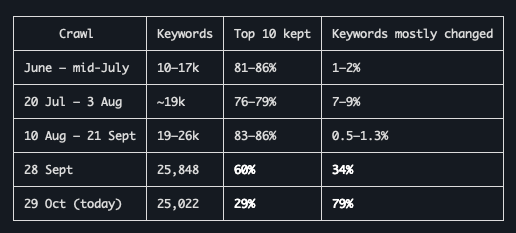
We run our own SERP scrapes and the pattern shows up clearly. The table tracks how much of the top ten stayed the same between crawls, and how many keywords changed substantially.
- Through the summer, 81 to 86% of the top ten held steady from crawl to crawl.
- On 28 September that fell to 60%, with 34% of keywords mostly changed.
- By late October it was 29% kept, and 79% of keywords mostly changed.
That last reading sits beyond the end of Nozzle’s published window, which closed on 21 October. These are different measurements, so the two sets of figures are not directly comparable, but the direction is the same.
What we are doing about it
There is no clean fix for this at the moment. It affects every tool that scrapes Google, whichever platform or provider you use. In the meantime:
- Running more frequent scrapes. Poisoning is mostly short-lived, so more data points reduce the chance a single bad crawl gets read as a real movement.
- Treating rank as directional. Ranks were always a means to an end, and right now they need more caution than usual.
- Cross-checking against Search Console. If a page looks like it has vanished from the results but Search Console still shows impressions and clicks, nothing has happened to the page.
- Working on a better method, which we will share once we trust it.
Two people tested what LLMs actually pick up from a page
The useful work in AI search at the moment is not coming from best practice guides. It is coming from people running tests on their own sites and publishing what happened. Two examples landed in October.
Jan-Willem Bobbink moved a B2B client’s AI citation rate from 23% to 54% without publishing a single new article.
What he changed was the services and solution landing pages, adding written statements about results their customers had actually got. Not a logo wall or a downloadable PDF, but plain sentences next to the service that produced them, like a named client seeing a 30% improvement in deliverability. The citation rate moved within two weeks of the last page going live.
His reasoning is the durable part. Service pages get retrieved when someone asks for the best vendor in a category, and the model then filters that set into a shortlist it will actually name. A page saying “we improve customer support” gives the model nothing to justify picking you over anyone else making the same claim. “Client X cut their support waiting times by 40%” hands it a reason it can repeat back to the person asking.
Siege Media ran the same question at scale, across 520 sites in 63 categories, measuring AI visibility through late September and October.
Brands with five or more credibility statements on the homepage had 62% more AI visibility than comparable brands with none. The effect grows fastest from zero to two and flattens around five.
A credibility statement is a specific, verifiable proof point. Siege only counted ones naming a source, a platform or a figure, which rules out most of the reassuring copy on a typical homepage. What counts:
- Review ratings with the count attached, not “highly rated by our customers”
- Analyst placements, such as a position in a Gartner Magic Quadrant
- Named customer results, the same thing Bobbink added to his service pages
- Scale stats: usage volume, countries served, years trading, uptime guarantees
- Security and compliance certifications
- Original research you have published, plus press mentions and customer logos
You can watch it working. Ask ChatGPT for the best link research tools and it pulls in Ahrefs’ 35 trillion link index and its 15 minute refresh cycle, both of which sit in plain text on the page it is reading.
The more interesting finding is where it does not apply. There was no obvious link for high-authority brands. Those already have enough third-party context on the open web that the models do not need the page to tell them. It is mid-authority and newer brands, where that context is thin, that get the lift.
One detail from their write-up that is easy to miss: LLMs often struggle to render images. Award badges sitting on a page as graphics with no text may never be recognised. Text around the image, or decent alt text, fixes it.
Both are upfront about limits. Bobbink calls his a strong signal rather than proof, given one client over two weeks. Siege say theirs is correlational, and that it held after controlling for Domain Rating and organic traffic.
The actual takeaway
It would be easy to read those two and come away with a checklist. Five statistics on the homepage, some logos, done.
That is not the lesson, and a checklist will be out of date by spring.
What both really demonstrate is a way of working. Bobbink formed a view about how models build a shortlist, changed one thing, measured it against a fixed prompt set, and published the result with its limitations attached. Siege took the same question across 520 sites and found the answer depends on how well known the brand already is. You would not arrive at that by thinking it through. You get there by measuring it.
Nobody has a settled playbook here. The engines change, retrieval behaviour changes, and anything billed as definitive AI search best practice is a snapshot of whenever it was written. So the habit matters more than the tactics:
- Form a specific view about how models are reading your pages, instead of applying generic advice.
- Change one thing and measure it against a consistent set of prompts.
- Keep a record of what you tried, including what did not work.
- Expect it to shift. What earns a citation today may not in six months.
It follows directly from where we left September’s roundup, on Wil Reynolds and everything you claim now needing a receipt. Two months on there is evidence behind that argument, and the open question is what else is true that nobody has tested yet.
Google says it is sending more traffic to the web
On 15 October, Google announced five changes to how AI Mode and AI Overviews show links:
- Inline links appear higher in responses, and more often.
- A test of a dedicated section at the top of the answer carrying one or two links to official sites, with context on why they are useful.
- News carousels expanded to more regions and languages, with the ability to prioritise a user’s Preferred Sources. Google says Preferred Sources usage has grown sevenfold.
- Related article links at the end of responses, now with image thumbnails.
- A test of clickable creator and publisher names on video results, linking through to their Search profiles.
Taken at face value this is good news, and the creator profile test in particular is something publishers and anyone running thought leadership should be watching.
The caveat is that Google has now announced more links to the web at least three times, each time framed as sending more traffic to publishers, and has never published click data to show whether any of it worked. Reddit’s numbers this month are the closest thing we have to an answer, and they point the other way.
AI Overviews are now the rule rather than the exception
Search Engine Roundtable reported this month that AI Overviews now appear on over 80% of Google searches, based on data from Semrush, SE Ranking and seoClarity.
There are nuances. SE Ranking saw AIOs on 82.5% of US brand searches while seoClarity reported 62% of queries overall, with ranges from 55% to 84% depending on industry. We would treat 80% as the direction of travel rather than a fixed number, and expect it to shift by tool, keyword set and country.
The brand search figure is the one to pay attention to. If a search for your brand name now regularly triggers an AI summary, what that summary says is part of someone’s first impression, and it is assembled from the sources around your brand rather than just your own website.
Which reinforces something we have said in several of these roundups: building visibility across a range of credible sources matters more than ever.
Meta’s new terms are putting publishers in the spotlight
Meta updated its commercial terms and gave publishers until 30 October to decide whether to stay on Facebook and Instagram.
The new wording lets Meta use automated tools to crawl both the domains and the pages linked to an account, and use what it collects to develop and improve its own products. Meta’s position is that the crawling terms only apply to its ads and business products, that nothing changes in how its web crawlers currently work, and that publishers’ robots.txt preferences will still stand.
The deadline has passed by the time you read this. The thing to watch is whether any publications you target for coverage change how they use Meta platforms, since that could affect how any coverage you earn gets distributed.
A recap: why Reddit still deserves a place in your DPR strategy
Finally, a nod to a post from one of our Senior Digital PR Strategists, Gideon Katz, written after a Roxhill x Reddit talk on why Reddit should be part of your comms strategy.
It makes the case for thinking harder about where and how a brand gets discussed: finding the right subreddits, listening before posting, making contributions that mean something to the audience you are trying to reach.
Worth reading alongside Reddit’s own earnings news above. Their referral traffic from Google has fallen off a cliff, and their revenue was still up 53%. The audience has not gone anywhere. If your customers are there, that is reason enough to be there too, whatever the referral data says this month.
So where does that leave organic?
Three reasons we think the case for organic is stronger now than it was a year ago.
The clicks that remain are worth more. If AI answers are filtering out the people who were never going to buy, whoever still clicks through has already compared their options and narrowed the list. They arrive far closer to a decision than they used to, which makes being visible at that moment more valuable than it has ever been.
Every part of the results page is its own battlefield. Earning a citation in an AI Overview is a different job from ranking in the traditional results, which is different again from a product grid, a local pack or a news carousel. Each one is won on its own terms, so we plan for them separately.
And Google is only part of search. Search Everywhere Optimisation is the philosophy we keep coming back to for a reason. Your audience is searching on YouTube, Reddit, TikTok, marketplaces and inside LLMs, and every one of those is a surface you can show up on.
So there is more to play for than there was five years ago. The work is spread across more surfaces and the measurement is harder. That is an argument for doing it properly.
Enjoyed this roundup? Stay updated with the latest organic trends, tips, and exclusive insights by subscribing to our newsletter.
Want cutting-edge digital news and tips straight to your inbox? Sign up to our monthly newsletter here
"*" indicates required fields