Latest organic search news – September 26
 Matthew Finch
 Ella Grappy
We’ve compiled the essential updates from Google and the broader world of search from the last month – keeping you up to date with everything you need to know.
TL;DR
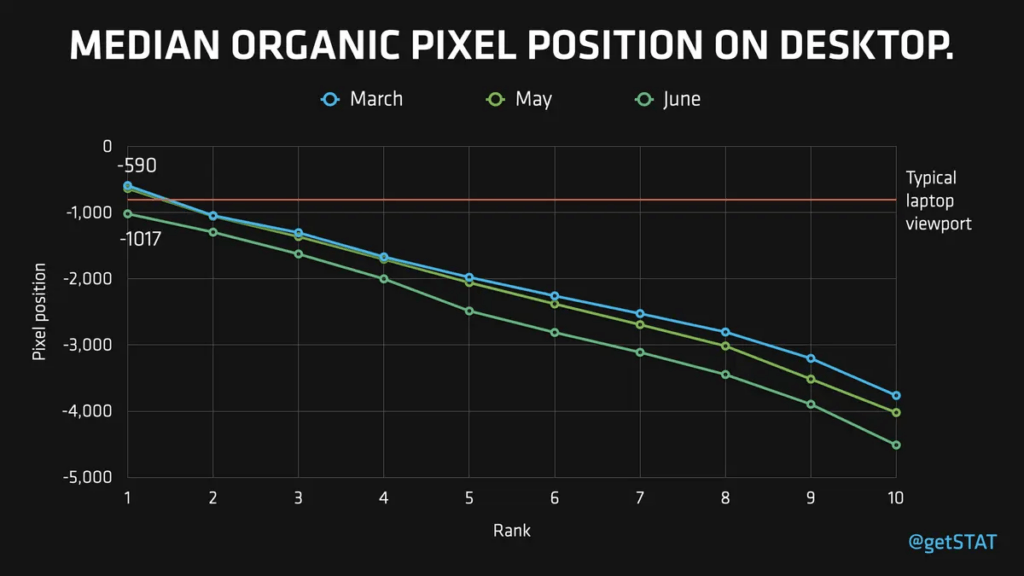
- Organic results are being pushed down the page, and this time AI Overviews aren’t to blame. New STAT data shows the median top organic result on desktop dropped from 590 pixels to 1,017 pixels between March and June – a 72% fall in just three months. The culprit:paid results growing more prominent and more frequent.
- On commercial searches, paid now takes 44.8% of the space above the fold. Paid and shopping between them have cut organic’s share from 31% to 11.5%.
- We found product grids sitting above every blue link on 42% of 6,000 ecommerce SERPs. The brand in question appears in 70% of those grids and still gets fewer clicks from them in a year than blue links deliver in a month.
- Splitting SERP scrape data by activity shows exactly who owns what. It also shows which third-party sites hold sway on your target terms, which turns competitor research into a partnerships list.
- LinkedIn posts are reaching search results fast, and if you skip the hashtags the first few words of a post decide its URL, so make them keyword rich!
- Reddit’s share of ChatGPT citations fell 86% in four days, but it’s barely moved on Google’s surfaces, and the audience hasn’t gone anywhere. As you were.
- What has zero-click marketing actually changed? See Rand Fishkin’s handy one-page map.
The organic click drop is not just about AIOs and LLM usage
If you’ve spent the last eighteen months explaining falling organic clicks to clients or to senior management, you have probably reached for one of two answers: AI Overviews resolving the query on the page, or people taking their search into ChatGPT and Gemini instead. Both are real, and both are growing.
But there is a third factor that has been building all year with none of the same fanfare. Ad prevalence has been climbing steadily through 2026, quietly taking space that organic used to hold. Since Google I/O in May, it has gone into overdrive.
Tom Capper at STAT published research on 18th August that’s one of the most important things to land this month.
Last year’s “Great Decoupling”, when clicks separated from impressions, was driven by a step change in AI Overview prevalence after Google I/O 2025. Something comparable has happened in 2026. This time it’s gone largely unnoticed, because this time it’s not AI-related.
AI Overview growth in 2026 has been modest. AIOs appeared in 22.9% tested results in June, an increase of just 2.9% since January.
Yet Organic’s position collapsed anyway.
- In March, the median highest traditional organic result on a desktop SERP sat at 590 pixels, just about inside the viewport of a typical laptop browser.
- By June, it had fallen to 1,017 pixels.
That is a drop of 427 pixels, or 72%, in three months, and it takes the average number one result below the fold on a normal laptop screen. The cause was a considerable expansion of paid results following Google I/O in May.
It was more ads and bigger ads, at the same time
This is the part to be precise about, because the two changes compound.
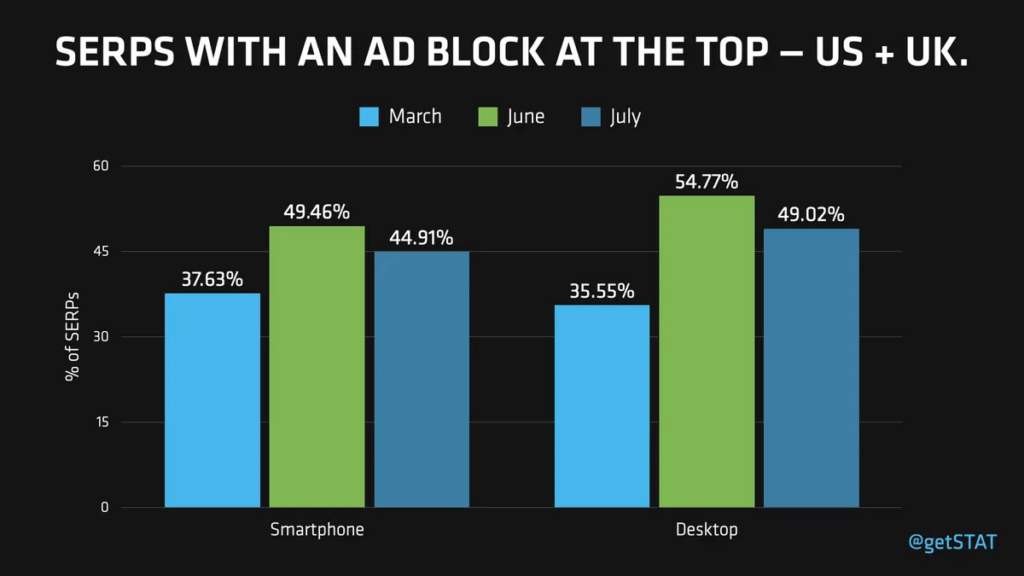
- More ads. The percentage of SERPs that start with a block of sponsored results grew by around 50% on desktop.
- Bigger ads. The typical size of those ad blocks nearly doubled on both desktop and mobile. This is the primary driver.
Put together, paid’s share of above-the-fold space, measured in pixel height, more than doubled between March and June, mainly at the expense of organic results.
Tom also points out that his figures understate it. The study only measures above-the-fold space, so it artificially cuts off ad blocks that are in fact more than a full screen tall.
It’s commercial SERPs that take the real hit
The pattern shows up across most intents, but the source of the pressure varies a lot by query type.
On informational SERPs, paid results are more prevalent than you would expect for terms with low commercial value, yet still account for only around 22% of the visual real estate. That represents more than a doubling of paid presence, alongside a drop of “only” around 27% in organic’s share, from 20.2% to 14.8% between March and July. AI Overviews remain the main threat here.
On commercial SERPs, paid now takes 44.8% of the above-the-fold space, again having more than doubled.
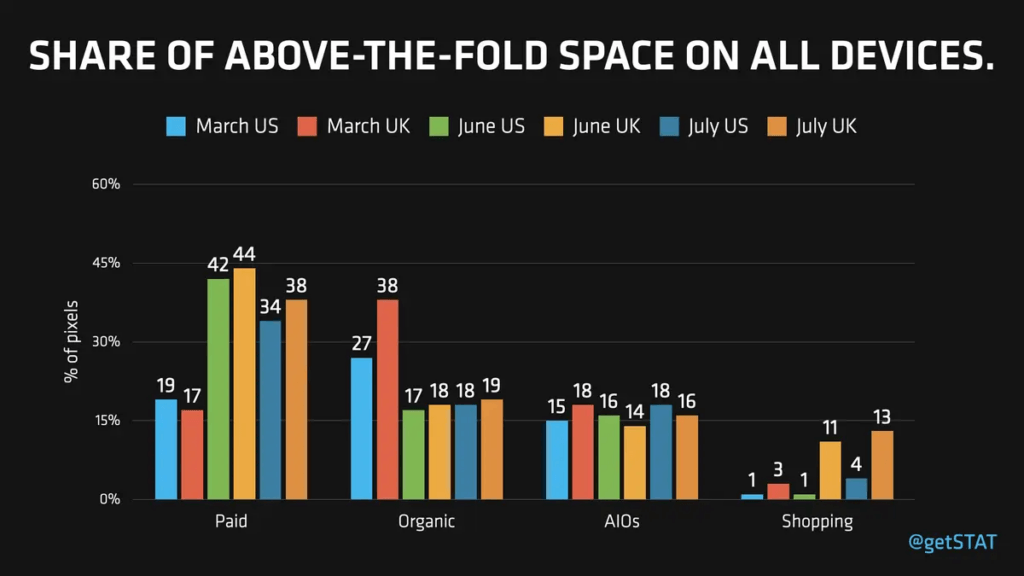
Between them, they have cut organic’s share by nearly two thirds, from 31% to 11.5%.
Why Google would do this
Google normally keeps a firewall between its search and ads teams, so that decisions about the product are not driven by revenue targets.
That wall has slipped before. Emails released during the US v. Google trial showed that when search revenue came in weak in 2019, Google put engineers on fixing it. Ben Gomes, then head of Search, told colleagues the team was “getting too close to the money”.
So there is precedent for commercial pressure shaping the search product.
Two things have changed:
- AI Overviews reduce the clickiness of search, which threatens Google’s own revenue model. That model depends on people clicking through. Initially AIOs only appeared on informational SERPs, which were rarely monetised, so the threat was minimal. They have since expanded well beyond that.
- AI answers are expensive. Google is investing record amounts in hardware and in the cost of generating each individual response.
So the commercial pressure is real, and the space above organic is the obvious place to relieve it.
The thread under Will Critchlow’s LinkedIn post about the research went somewhere less charitable.
Will’s first question was whether Google is hitting its numbers by juicing the SERP as people drift towards AI discovery. It was then noted that Google has historically made changes like this right before it needs to hit its targets. Tom’s own reply was that competitive pressure from AI has pushed Google to cross lines it previously would not have.
None of that is provable here but when a results page that has carried ads for twenty five years changes this much in three months, the question of timing is a fair one to ask.
We have been saying this since February
This is not a new argument for us, and it is not new for the industry either.
Back in our March roundup we covered Aleyda Solis’s study from February, which used Similarweb data across four US verticals to test exactly this hypothesis. Her findings pointed the same way:
- Classic organic click share fell in every single vertical, from 73% to 50% in headphones, 73% to 56% in jeans, 88% to 75% in greeting cards and 95% to 84% in online games.
- Text ads were the biggest winner everywhere, gaining between 7 and 13 percentage points of click share.
- In product verticals the paid share roughly doubled in a year once PLAs were included. Headphones went from 16% to 36%, jeans from 18% to 34%.
Her conclusion was that search is not only turning to AI, it is being remonetised. Tom’s data now gives that argument a pixel-level mechanism.
At the time our advice was to track SERP features and pixel depth alongside rankings. Six months on, that has gone from sensible housekeeping to the only way to see what is actually happening on your SERPs. And once you know that, you can start to pick your battles – what would you rather be below?
What to do about it
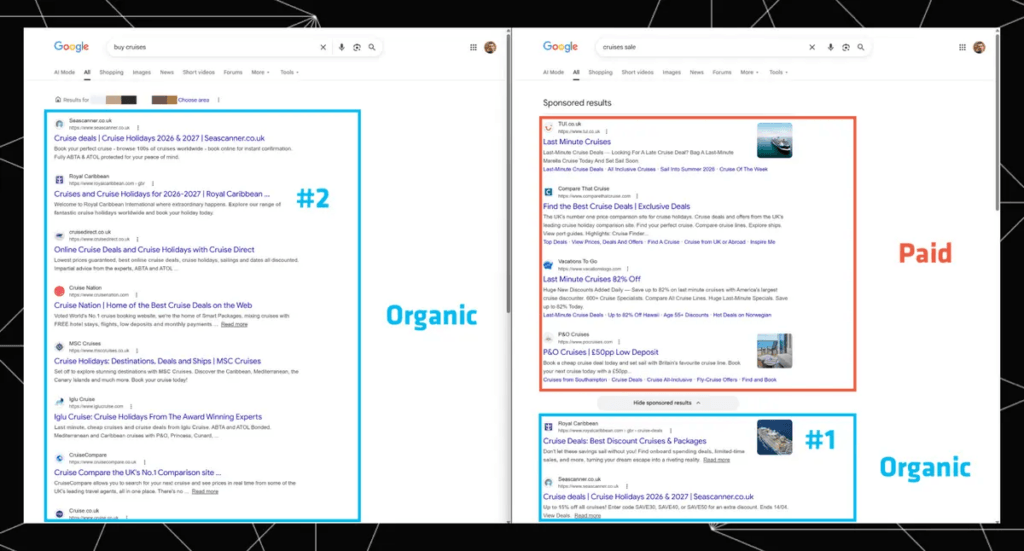
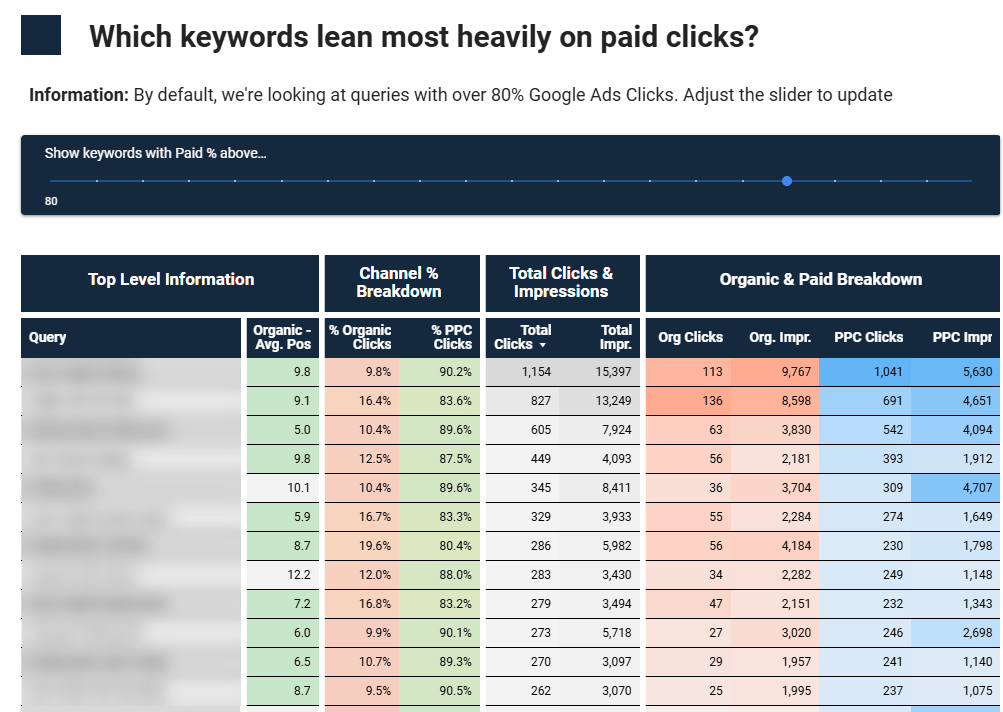
Diagnose before you prescribe. If organic traffic is down, the reflex is to blame AI Overviews and chase citations. On commercial terms in particular, the more likely answer is that paid units have physically pushed you down the page. That is a very different conversation, and it starts with your PPC team. We have been building detailed combined dashboards for a little while now which help paint a picture a lot more visually than is otherwise possible:
Report on visibility as well as rank. A number one ranking now tells you where you sit on the page, which is a different question from whether anyone can see you. Positions reported without pixel context tell a story that stopped being true some time ago.
Treat SEO and paid as one conversation. We made this point in March and the case has only got stronger. If nearly half the above-the-fold space on your commercial terms is paid, deciding where organic can realistically compete and where paid covers the gap becomes a single strategic decision.
Run the analysis on your own keywords. What sits above you is vertical-specific, and some of it is winnable while some of it really is not. Industry averages won’t tell you which situation you’re in.
What that looks like on a real ecommerce account
Our own data lands in the same place, from the other direction.
Cameron Sykes, one of our Senior SEO Managers, spent last month digging through Google results for over 6,000 keywords for an ecommerce brand. Two findings stood out.
- A product grid appeared above any blue link on more than 2,500 of those SERPs. That is 42% of the keyword set.
- The brand has more product listings than anyone else in its space, and appears in at least one listing on 70% of those grids. Genuinely strong coverage. And yet it has had fewer clicks from product listings in the last twelve months than it gets from blue links in a single month.
Part of that is simple arithmetic. You can fit ten product listings into the space that holds two blue links, so more links across the same area means a lower average click-through rate for each one. But the size of the gap still points at a real shift in how people are using these pages.
It also sits squarely inside Tom’s finding. On commercial SERPs, paid and shopping have taken the space organic used to hold. Winning the grid has become table stakes, but in this instance, you certainly need to back this up with high traditional rankings too to win the clicks.
Chunking SERP data by activity to find the gaps
Something we’ve been experimenting with at Distinctly is finding better ways to cut and present SERP scrape data. This example came from thousands of keywords in the leisure and entertainment sector.
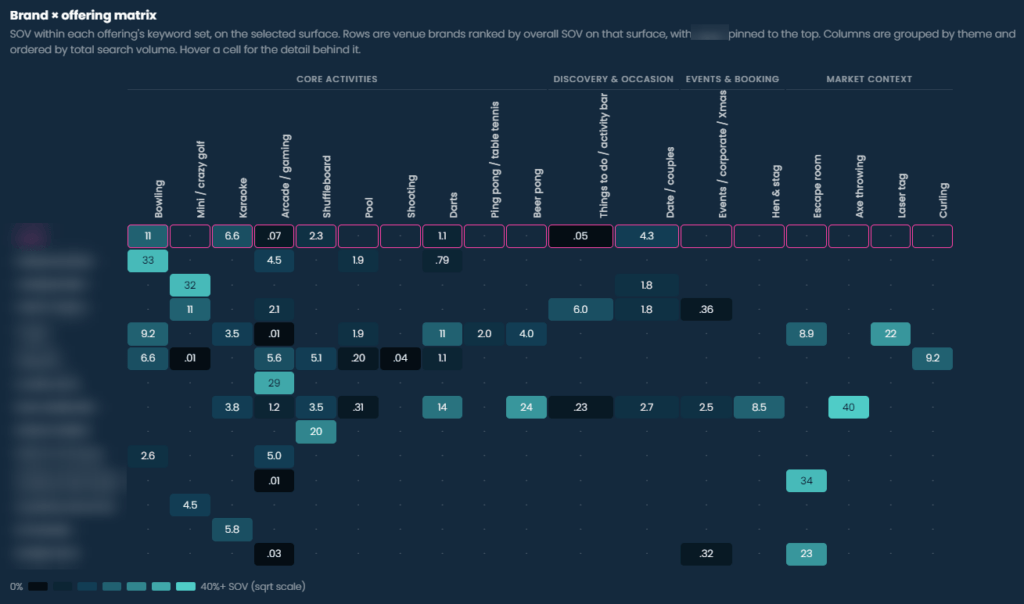
The first view plots venue brands against keyword themes, grouped into core activities, discovery and occasion, events and booking, and market context. Splitting the keywords by activity, instead of lumping them together, makes two things obvious at a glance:
- Who is winning what. Individual competitors dominate individual columns. One owns bowling, another owns mini golf, another owns arcade and gaming.
- Where the white space is. Several columns are barely contested by any of the main rivals, which is a useful starting point for a digital strategy and can inform future business decisions, too.
The same approach applied to third-party sites is arguably more useful again.
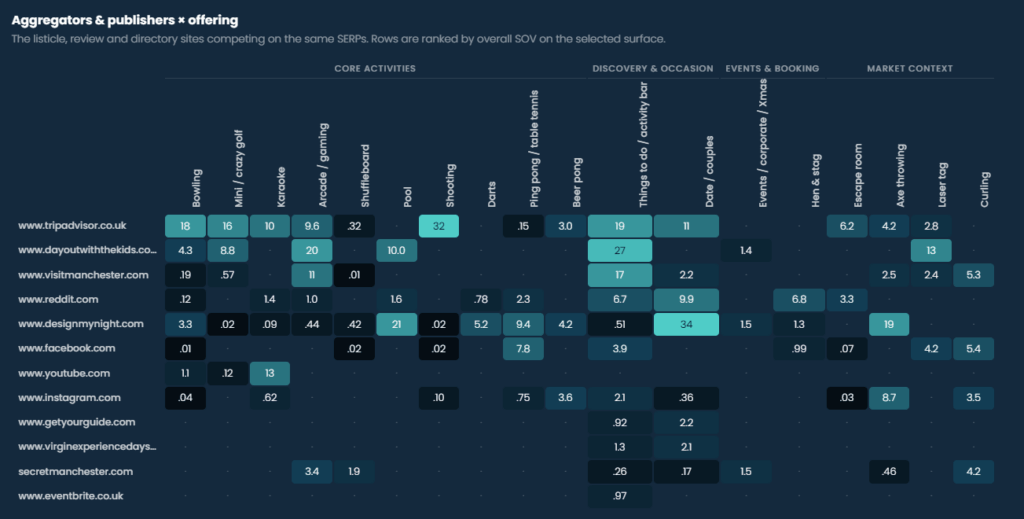
This view shows the listicle, review and directory sites competing on the same SERPs, ranked by overall share of voice. Tripadvisor, Day Out With The Kids, Visit Manchester, Reddit and DesignMyNight all hold meaningful positions, but on different themes.
That turns a piece of keyword research into a target list. These are the sites to approach, partner with or otherwise work into your plans, chosen on the basis of where they actually hold sway for your terms and not on authority or readership alone.
It also connects to something we covered last month. Seer’s research found that the page types carrying the most weight in AI answers are mostly ones you earn, not ones you own. This is one way of working out which of those earned opportunities are worth the squeeze.
Fresh evidence that LinkedIn posts reach search results fast
A cool experiment from Jesper Nissen this month. He published a LinkedIn post, optimised it for search, and had it surfacing for his target term within minutes, along with an AI Overview citation.
His method was straightforward:
- Lead with the target query in the opening line
- Write around 300 words of genuinely useful text so Google has context
- Leave the hashtags off
- Copy the post link from the three-dot menu, load it in a browser, and let it redirect to the clean URL
- Submit that URL for indexing
The mechanic in step three is the part most people do not know. Without hashtags, LinkedIn builds the post slug from the first six to ten words. Your opening line is writing your URL, and adding hashtags costs you that.
To be clear, the term he targeted was long-tail with very little competition, so the speed is the story here and not the ranking itself. You shouldn’t expect the same on a commercial head term.
But it’s a free thing to get right on posts you were writing anyway, and another example of the search everywhere principle we keep coming back to – it also makes your existing content outputs work that bit harder for you.
Reddit’s ChatGPT citations fell off a cliff, and it matters less than it looks
A useful reminder this month of how quickly things can change in AI visibility. The Drum reported that Reddit citations in ChatGPT Search fell by more than 86% over a four-day period. Reddit had been averaging 3.83% of ChatGPT citations, the highest share of any platform, before dropping below 1%. Petra Labs saw a similar pattern, with Reddit citations down around 80%.
Nobody knows exactly why, and PromptWatch have been upfront that their own figures are provisional.
Two things to know before anyone reacts to it.
- It looks specific to ChatGPT. Reddit is still cited by Google AI Overviews and AI Mode, where declines over the same period were far smaller.
- It wasn’t only Reddit. Petra Labs recorded drops across the user-generated web in the same window, including YouTube, TikTok, LinkedIn and Facebook. That points at a decision on OpenAI’s side, not at anything Reddit did or anything brands did to it.
None of which means Reddit is something to now ignore. Reddit is used by millions of people every day, and if those people match your customer profiles then it is a platform to be active on whether ChatGPT is citing it this month or not. The audience has not gone anywhere. One model’s retrieval behaviour has changed.
What it does reinforce is the value of building visibility across a range of relevant, authoritative sources rather than becoming reliant on a single platform or citation pattern (as always).
A useful map of what zero-click marketing actually changed
Rand Fishkin posted a single-page summary this month of how zero-click has changed marketing, channel-by-channel. It’s a good thing to close on, because it puts a shape on everything above.
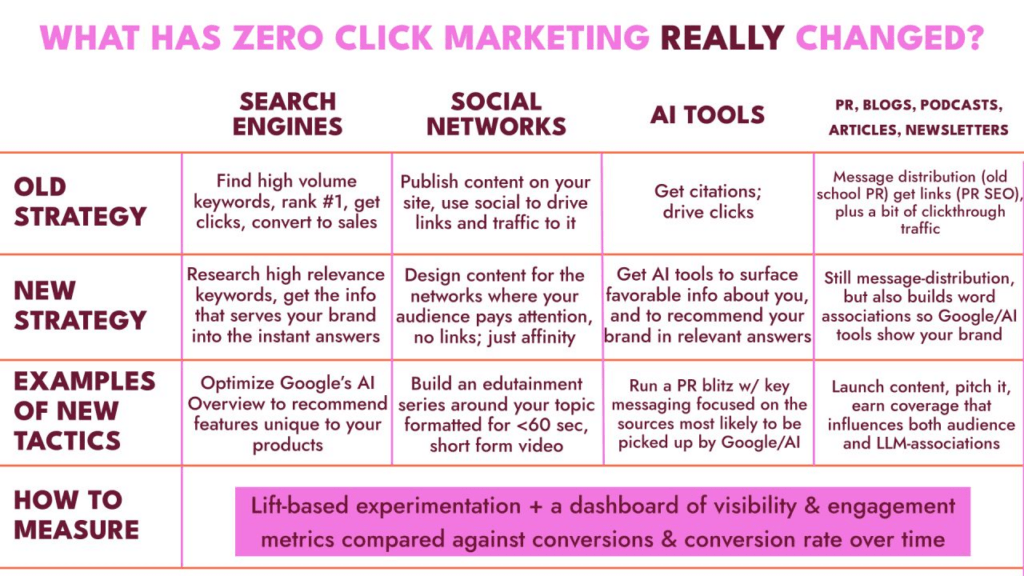
The through-line is consistent across search, social, AI tools and PR. The old strategy was to earn the click and convert it. The new one is to get information that serves your brand into the place where the answer is given, and to stop expecting the click at all.
A few of the shifts worth pulling out:
- Search. From finding high volume keywords and ranking first, to researching high relevance terms and getting brand-serving information into the instant answers. Visibilty matters more than ever.
- Social. From using social media to drive links back to your site, to designing content for the networks where your audience actually pays attention, with affinity as the goal instead of traffic.
- PR. Still message distribution, but now also building the word associations that make Google and AI tools surface your brand.
The measurement row runs across all four channels and it echoes what’s come up again and again in this month’s post: run lift-based experiments, keep a dashboard of visibility and engagement metrics, and measure against both conversions and conversion rate over time.
Three separate pieces of work, all landing in the same place. Tom Capper’s pixel data shows that ranking first no longer means being seen. Our own numbers show that being seen no longer means being clicked. Rand Fishkin’s framework says to stop treating the click as the only thing worth counting in the first place.
If your reporting still measures clicks and nothing else, it is describing a shrinking part of what search actually does for you.
Enjoyed this roundup? Stay updated with the latest organic trends, tips, and exclusive insights by subscribing to our newsletter.
Want cutting-edge digital news and tips straight to your inbox? Sign up to our monthly newsletter here
"*" indicates required fields