What Should You Even Be Measuring in SEO and AI Search in 2027?
 Dave Westby
When setting out a digital marketing strategy, you need data to make decisions or you’re flying blind or just going off your gut.
Within the SEO and AI visibility world, we’ve had to adapt to a couple of pretty spicy changes:
- The research stage has changed – People who used to use Google exclusively to do their research are now using ChatGPT, Claude and the like. That’s a whole new thing to measure.
- Google is keeping the clicks – Click-through rates to websites are down, with Google’s SERP features taking up so much more SERP real estate – especially with the increasing prominence of AI Overviews.
What these changes have meant is a big change in mindset and focus.
The days of focusing just on blue link rankings are long long gone, and AI has forced digital marketers to really step up.
We have to think holistically about where (and HOW!) our clients show up across different platforms people search from, AI included.
In this blog I’ll cover:
- How the search world has changed
- Why measurement has had to change with it
- How we’re measuring SEO and AI visibility going into 2027
How the search world has changed
SEO used to be simple
Imagine it’s 2010, you want to buy hiking boots.
You Google “waterproof hiking boots”, get ten blue links, click on different websites, compare prices and you’ve got your hiking boots.
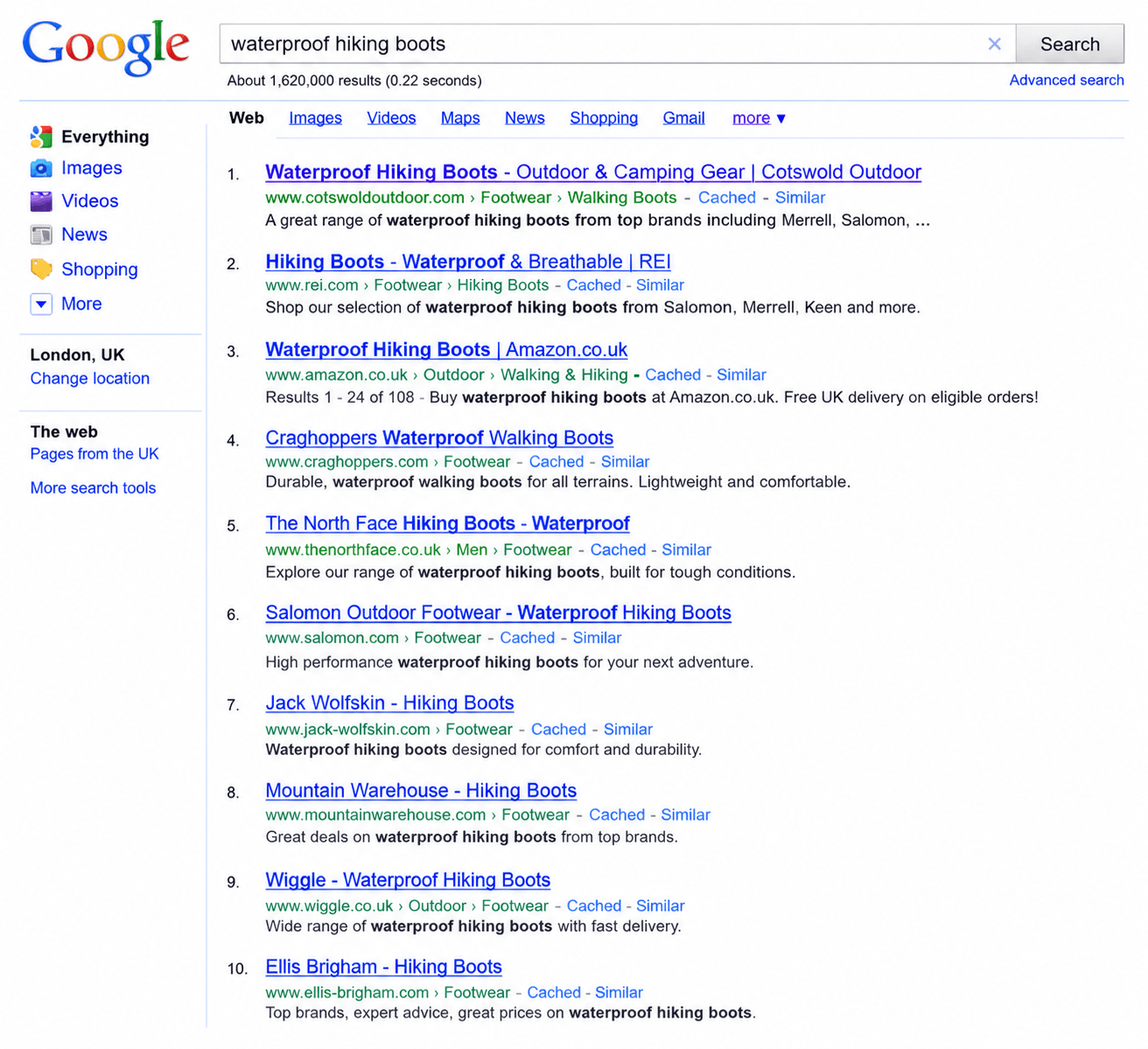
Pretty much each step of that is measurable.
You can see:
- The ranking
- The click
- The session
- The pages they looked at
- The sale.
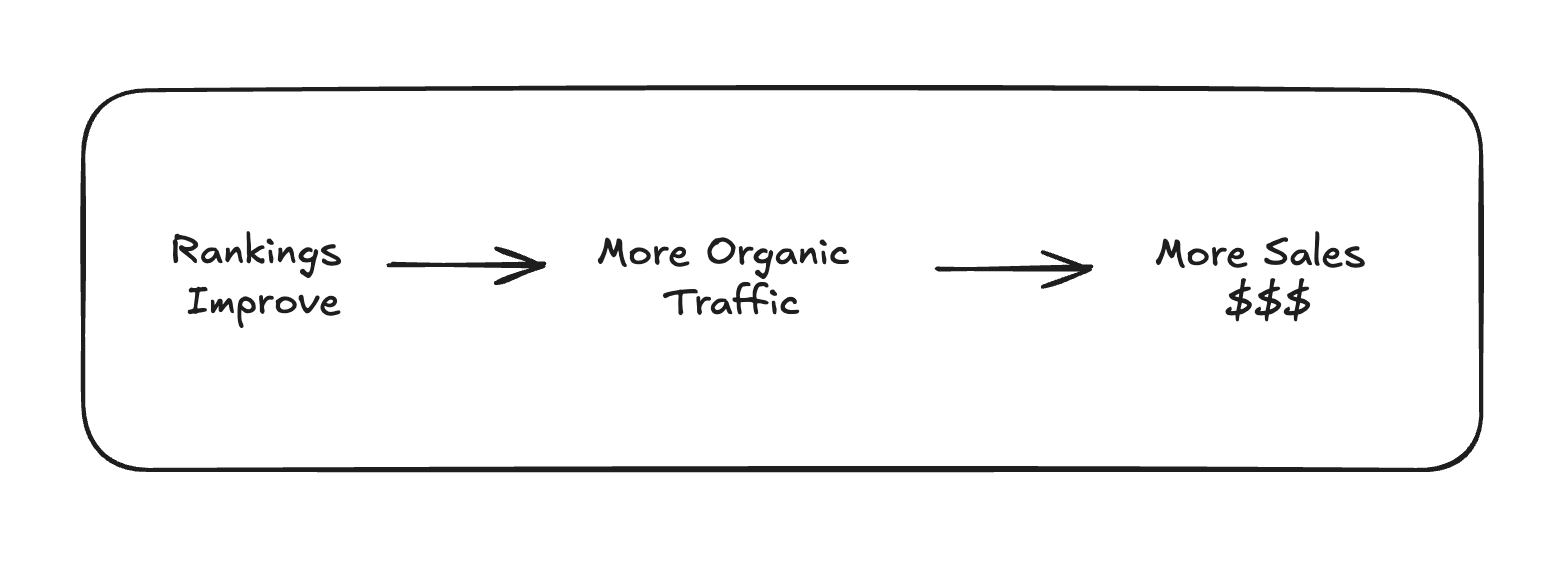
In general, what you’d basically see was that if rankings improved, organic traffic went up and sales followed.
Since then Google has introduced a tonne of SERP features
Google went from ranking different websites to providing a load of answers in different formats.
At this point we now have so many different SERP features including:
- The Local Pack
- Knowledge Graphs
- Featured Snippets (though these are being phased out now)
- People Also Ask boxes
- Discussions & Forums
- Videos & Short Videos etc
Looking at the same SERP for “waterproof hiking boots,” we can see how many more different SERP features there are:
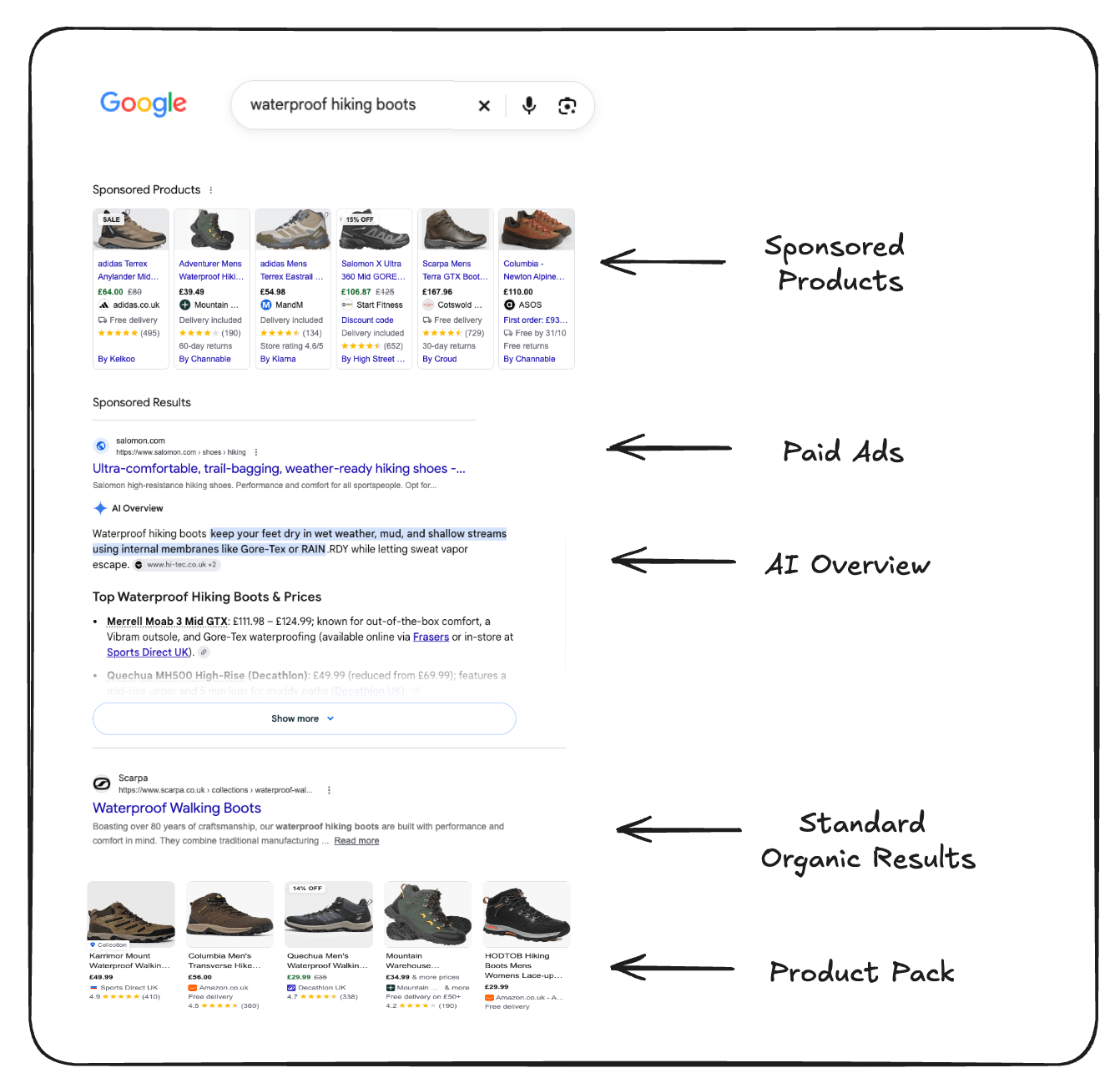
We have SERP features like:
- Shopping results and product carousels
- An AI Overview explaining what to look for
- People Also Ask boxes
- YouTube reviews
- Reddit threads from people who’ve worn them in the rain
And of course we have Paid ads taking up a huge chunk of the SERPs as well.
AI Overviews are taking a big chunk of the clicks
Buyers used to click through several sites from Google, read the reviews and compare options themselves. Now Google does that comparison for them.
Going back to the hiking boots example, this is the AI overview.
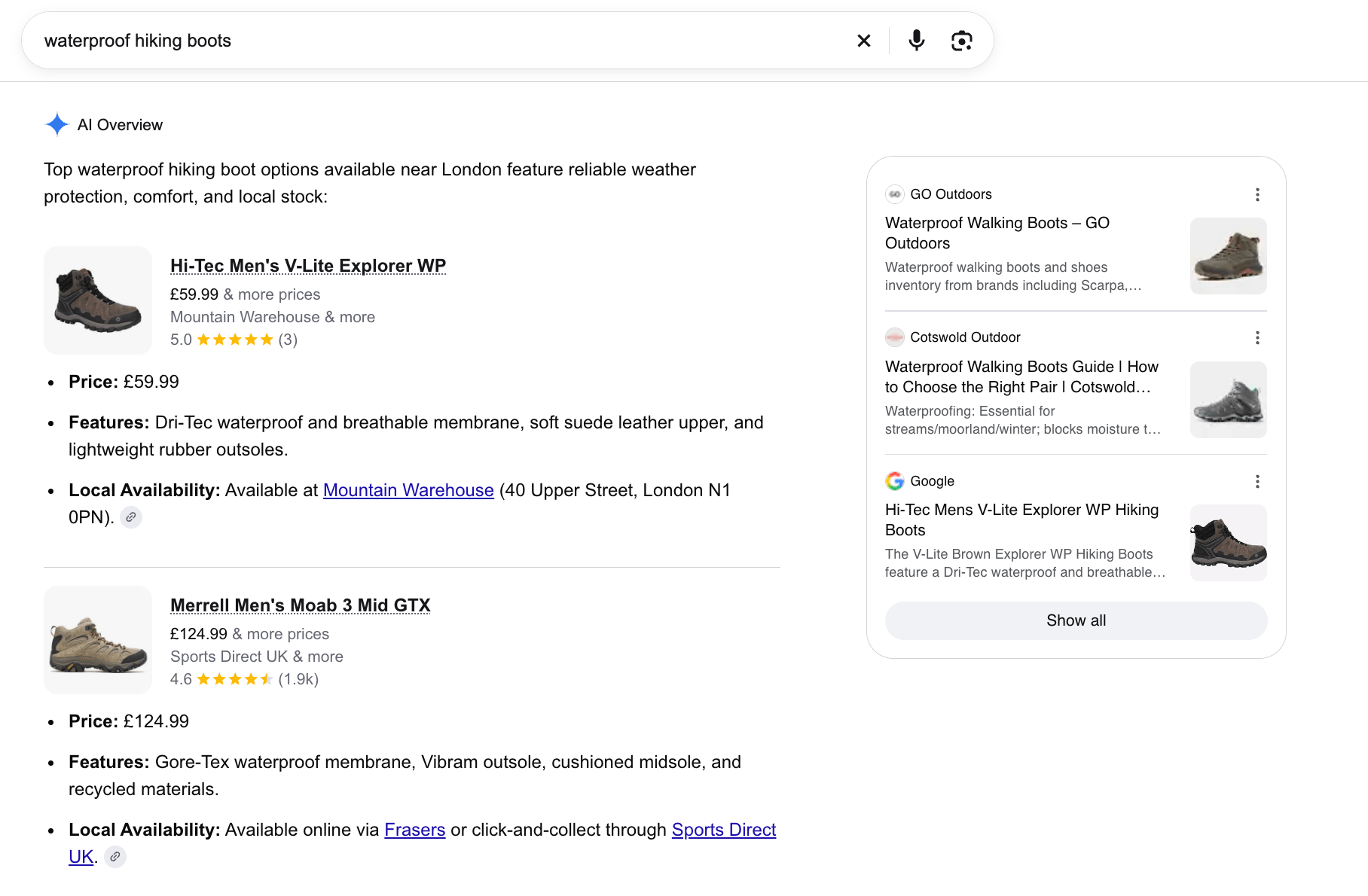
One study by Ahrefs found AI Overviews correlate with a 58% lower click-through rate for the top-ranking page.
We see this with our own clients too. We have seen impressions increase, especially for informational terms, but the number of clicks decline.
Alongside this, a lot of the research has left Google altogether
More and more of the research now happens in AI tools like ChatGPT, often right through to the decision.
Back to the hiking boots.
You might ask ChatGPT which boots suit wide feet, go back and forth on Gore Tex versus leather, and come away with a shortlist of three.
None of that happens on Google, but it’s where the shortlist gets made. That’s why being visible and received in a positive light here matters so much.
And ChatGPT isn’t the only place people research:
- YouTube
- Amazon
etc
So a real journey might look like this.
You ask ChatGPT for options, check Reddit to see what hillwalkers say, go back to ChatGPT to narrow it down, and watch a YouTube review. Then you search the brand name on Google and buy.
That’s five touchpoints across four platforms. GA4 sees only the last one and reports the sale as Organic Search, or worse, (direct).
Bringing it onto how we measure all this stuff
Fundamentally the question that we want to be asking is:
“Are we in front of the right people when they’re deciding what to buy?”
In the old SEO world, a ranking basically felt like it answered that question.
With the new search landscape, we still need to ask that fundamental question, and make sure we’re shaping our strategies and tactics around that. The key difference is that we’re not just looking at classic blue link rankings anymore.
AI has made brands have to be more honest
If there are a tonne of negative reviews about your product or service, AI will surface them or if competitors offer a better service, AI will likely recommend them.
This, in my opinion, has changed the role of an SEO or search consultant to be far more focused on how our clients show up across all search engines and not just obsess over rankings like we’re in 2008.
Our priority focus is on three core areas (though we could and do expand this to other platforms as well).
- The search results: How visible are you across the whole SERPs? What SERP Features are appearing? What can we do to compete for them?
- AI answers: Are you named when buyers ask the questions that matter? Are you mentioned in a positive light?
- Your site: When they turn up, do they convert? How do they convert?
Layer 1: Measuring the whole of Google’s search results page
Our internal SERP tracking tool measures the share of voice across every feature on the page, not just the blue links. It’s split into three views:
- Share of Voice – For this we look at our Share of Voice across different SERP features including:
- Blue links: estimated traffic based on position and search volume.
- AI Overviews: your share of the citations.
- Local pack: visibility weighted by where you sit in the pack.
- People Also Ask: how often your pages are the answer.
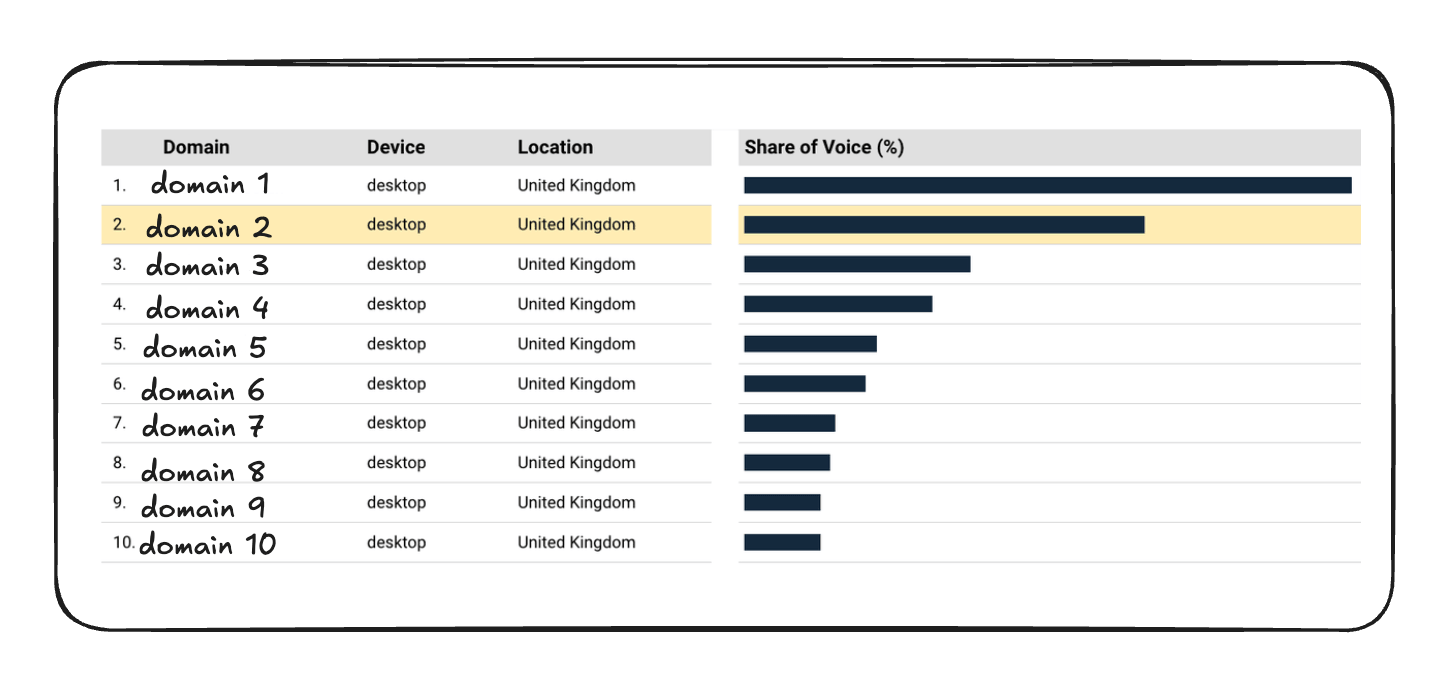
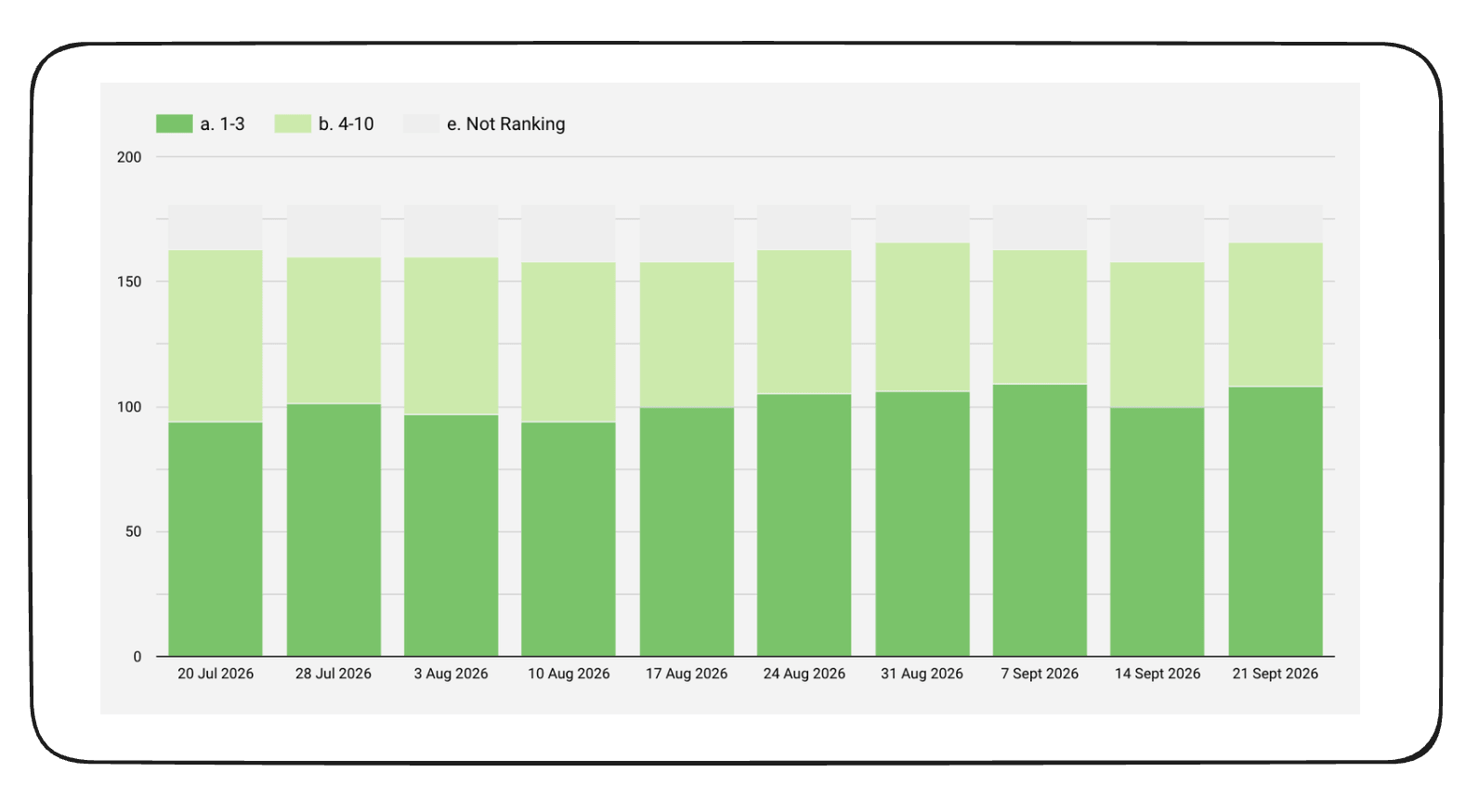
2. Rankings – Standard ranking distributions over time and then rankings
3. SERP Features Deep Dive – This allows us to see changes in the SERP features and dive into the specifics of each of them.

Layer 2: Measure who AI names and which sources it trusts
This is the new type of measurement we’ve had to get used to over the past few years.
Blog traffic used to be how we proved content worked in terms of speaking to our ICPs, helping them to move along the funnel and eventually converting.
As we know, AI now answers a lot of those early questions itself, so good content can look like it’s failing when it’s actually the reason AI recommends you or why you’re consistently mentioned within a conversation.
For BOF pages and content, there haven’t been the same drop offs with traffic, but we still need to measure how visible they are.
So what we do is measure how much we’re appearing in the answers of different prompts and also the sentiment of your brand within those answers also.
There are 3 steps here:
1. Write the prompts around your buyers
The prompts are built from your ideal customer profiles.
This should focus on their needs, and the questions they ask right before they buy.
A trail runner and a marathon runner need very different shoes, so they ask very different questions.
| Best for my needs | Head to head | Is it right for me? | |
| Trail runner | “best trail shoes with cushioned support for long distances” | “[Brand A] vs [Brand B] trail shoes for rocky terrain” | “is the [Brand A] [Model] good for wide feet” |
| Marathon runner | “best marathon shoes with carbon plates” | “[Brand A] vs [Brand B] – which is better for my training” | “is the [Brand B] [Model] worth it for a sub-3 marathon” |
| 5k racer | “best 5k racing shoes for a forefoot striker” | “[Brand A] [Model] vs [Brand B] [Model] for parkrun” | “is the [Brand A] [Model] too stiff for short races” |
| Injury-prone runner | “best stability shoes for overpronation and shin splints” | “[Brand B] vs [Brand C] for plantar fasciitis” | “can I run in the [Brand C] [Model] with knee pain” |
We then track them every day across different AI Search Engines.
2. See who gets named, and which sources AI uses
For every answer, we look at two things:
- Who’s named: you, your competitors, and how consistently from day to day.
- What’s cited: the pages AI read to write the answer. These might be yours, a competitor’s, or third-party sites such as review sites, “best of” lists and Reddit.
3. Turn it into decisions
The data points to two kinds of decisions.
Strategic: where to invest
- YouTube reviews: if AI keeps citing the same three YouTube reviewers when it answers “best marathon shoes with carbon plates”, then you could consider a partnership with them.
- A Reddit strategy: if r/trailrunning keeps turning up in answers about cushioned trail shoes, then you may want to look at how you can influence the conversation.
- Pages you don’t have yet: if AI answers “best stability shoes for overpronation” using competitors’ guides because you don’t have one, that should be part of the plan.
Tactical: what to fix now
- A page AI reads without naming you: AI might read your trail shoe page for “best trail shoes for wide feet” and still recommend someone else, because the page never says it comes in a wide fit.
- Details AI gets wrong: if AI says your racing shoe has a 10mm drop when it’s 6mm, update the product page and the specs on the retailer listings it’s reading from.
Layer 3: Measure what happens when they land on your site
This step is about what they do once they’re on the website. It’s standard GA4, but some teams only look at sessions and stop there.
We look (broadly!) at four things:
- How people move around the site. Where do visitors land, and where do they go next?
- How they convert. We compare conversion rate by channel, and by landing page within each channel. Visitors from AI often arrive further along in their decision.
- Where they drop off. A funnel from product page to basket to checkout shows exactly where people give up. If marathon runners add shoes to the basket and then leave at delivery costs, that isn’t a search problem, and no amount of visibility will fix it.
- Which pages help drive conversions. Some pages rarely convert themselves but appear in the journey of people who do: a sizing guide, a shoe comparison, a “which shoe is right for me” quiz.
Need help with your AI Visibility & Search Strategy
If you want help analysing your AI visibility and setting a strategy that acts on it, that’s what we do.
Contact us today.
Want cutting-edge digital news and tips straight to your inbox? Sign up to our monthly newsletter here
"*" indicates required fields