Latest organic search news – May 26
 Matthew Finch
We’ve compiled the essential updates from Google and the broader world of search from the last month – keeping you up to date with everything you need to know.
TL;DR
- Google has a name for what it wants from content, and it isn’t “helpful”. At Search Central Live Toronto, Danny Sullivan introduced the commodity vs. non-commodity content framing. The practical bar is higher than most brands are currently hitting.
- Several other useful things came out of Toronto. Including clarity on blocking Google-Extended, the indexing quality bar, and confirmation that converting your site to Markdown does nothing.
- LinkedIn is now the second most cited domain across AI platforms. New Semrush research across 325,000 prompts puts it ahead of Wikipedia and YouTube, with individual profiles outperforming company pages on ChatGPT and Google AI Mode.
- AI citation patterns vary significantly by platform. BrightEdge data shows source overlap as low as 16% across the major AI engines, which has real implications for where PR effort goes.
- Journalists are moving to Substack. It’s accelerating, and media lists that don’t account for it are already incomplete.
Google names the content problem: commodity vs. non-commodity
The biggest talking point from Google Search Central Live in Toronto this month was Danny Sullivan’s framing of content into two camps: commodity and non-commodity.
Commodity content is content that anyone could produce. Standard advice, generic structure, information that exists across dozens of other pages in nearly identical form. It isn’t necessarily bad, but it’s interchangeable, and that’s the problem. If your page disappeared, another would fill the gap without anyone noticing.
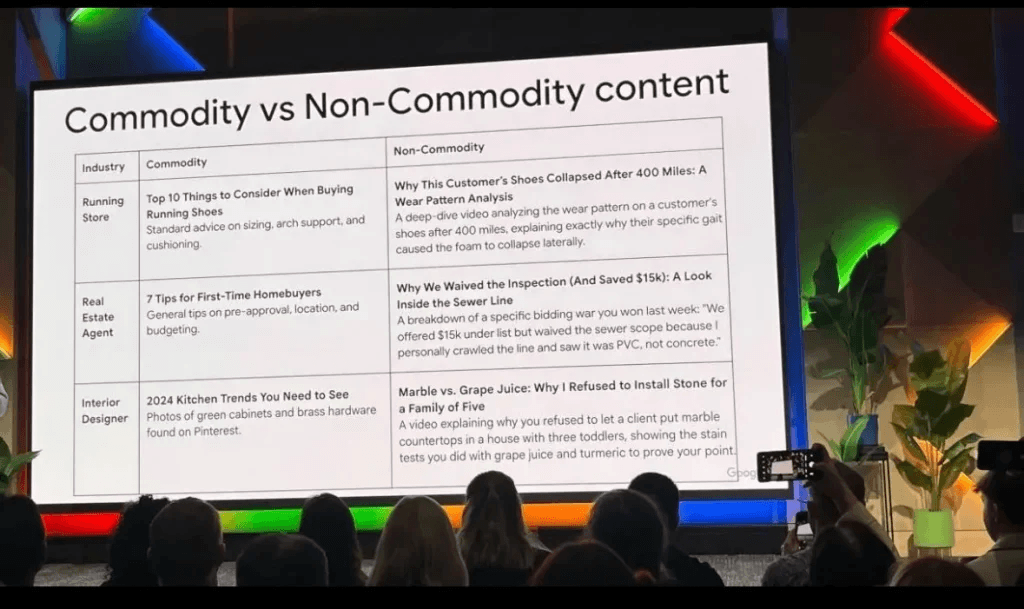
Non-commodity content, by Sullivan’s definition, has three properties: it’s unique (brings something others can’t easily replicate), specific (a real instance, not general guidance), and authentic (rooted in genuine first-hand experience or expertise).
His examples were deliberately concrete. For a running store: commodity is “Top 10 Tips When Buying Running Shoes.” Non-commodity is a detailed breakdown of why a specific customer’s shoes deteriorated after 400 miles, mapped to their gait pattern. The difference isn’t polish or length. It’s whether the content could only have come from that source.
Lily Ray’s comment on this is worth a highlight in response to this framing. The obvious next question for many marketers will be: “how do I automate non-commodity content with AI?” The answer, she argues, is that the entire point is that you can’t. Real experience, real mistakes, real product testing, real opinions – these are the inputs AI doesn’t have access to. The sites that succeed long term will be the ones where AI assists the process but the expertise is genuinely human.
This isn’t a new concept. It’s an extension of what Google’s quality rater guidelines have emphasised for years, and it closely mirrors the direction of the March 2026 core update. What’s changed is the terminology and the directness. Google is now saying plainly what it wants, and the bar for what counts as useful, original content is only going up as AI makes the production of generic content easier.
The practical implication for brands: content audits now need to ask not just “is this well-written and relevant?” but “is there anything in this that only we could have produced?”
Other things worth noting from Toronto
A few other practical clarifications came out of the same event that are worth having on your radar.
Blocking Google-Extended doesn’t do what most people think. Google-Extended is a robots.txt token that controls whether your content is used to train Gemini and Vertex AI models – but it has no effect on AI Overviews or AI Mode. Because your site is already in Google’s index, blocking it only removes you from grounding and linking in AI answers. Google can still draw on your indexed content through “fanouts” to generate responses. You lose the citation; Google keeps the information. The only mechanism that genuinely prevents specific content from appearing in AI Overviews is data-nosnippet, applied at the element level, or nosnippet at the page level – both of which also remove your snippet from standard organic results, which is a meaningful trade-off for most sites. Google’s own documentation is clear on this, but it’s still widely misunderstood.
“Crawled – currently not indexed” is almost always a quality signal, not a technical one. As AI continues to lower the barrier for content creation, Google has responded by raising the bar for what actually gets indexed. The Google team were explicit at Toronto that this status rarely indicates a rendering issue. If pages are sitting unindexed without an obvious technical cause – no robots.txt block, no canonical conflict, no 4xx – quality is the more likely explanation. Content that Google “tried and didn’t find useful” is the framing they used.
Converting your site to Markdown has no SEO benefit. Neither does creating an llms.txt file. Both were confirmed at the event and separately by JC Chouinard. There are no special file formats or markup structures required to appear in AI Overviews or AI Mode – Google’s documentation states this directly. If you have clients or internal stakeholders asking about either of these, the answer from Google is straightforward: focus on content quality and standard SEO fundamentals instead.
LinkedIn is now the second most cited domain in AI search
New research from Semrush, covering 325,000 prompts across ChatGPT, Google AI Mode and Perplexity, found LinkedIn URLs appearing in 11% of all AI responses on average, rising to 14.3% on ChatGPT alone. That puts it ahead of Wikipedia, YouTube, and every major news publisher in the dataset.
A separate analysis from Profound, tracking 1.4 million citations across six AI platforms from November 2025 to February 2026, found LinkedIn’s domain rank on ChatGPT climbed from around 11th to 5th in a single quarter – the largest domain authority shift Profound observed across the entire period.
A few findings from the Semrush data stand out:
- 59% of cited LinkedIn content on ChatGPT and Google AI Mode comes from individual profiles, not company pages. Perplexity flips this, with company pages dominant – which suggests a full strategy needs both.
- Articles between 500 and 2,000 words account for 50-66% of citations depending on the platform.
- Engagement doesn’t predict citation. Consistency does. Most cited posts had only 15-25 reactions, but 75% of cited authors had posted at least five times in the prior month.
- There’s a “ghost citation” problem worth knowing about. When AI uses content as a source but the brand isn’t explicitly mentioned in the response, citation rates drop from 53% to 10.6%. Brand name, company, and positioning need to be front-loaded in the content, not implied.
The semantic similarity finding is also worth sitting with: Semrush found a score of 0.57 to 0.60 between LinkedIn content and the AI responses that cite it – meaningfully higher than Reddit or Quora. When AI cites a LinkedIn post, the language used tends to closely reflect the original. The terminology a team uses in their posts has a real chance of appearing in a buyer’s AI research session.
The practical implication is straightforward: consistent, substantive posting from individuals – not company pages – is now part of how AI search perceives a brand in B2B contexts.
New study highlights AI citation patterns and preferences – and why it matters for digital PR
Research by BrightEdge analysing citation behaviour across a range of AI search engines has reinforced just how fragmented (yet, strategically important) this space has become. The study compared five major platforms (ChatGPT, Google AI Overviews, Google AI Mode, Google Gemini, and Perplexity), and found that while they all tend to converge on citing recognised brands, the actual sources they pull from can vary massively depending on the engine.
According to the findings, overlap in cited sources ranges from 16% to 59% across the platforms, meaning that each draws from a variety of information sources. But, interestingly, this contrast is less pronounced at a brand level. The same analysis found that brand overlap sits between 36% and 55%, which suggests that while AI systems may cite different publishers, they often still reference the same underlying brands or entities.
The scale of variation in source diversity was also a really interesting finding – ChatGPT was shown to cite a significantly broader mix of domains, while other platforms rely more heavily on a smaller pool of high-authority sites. What the data makes clear is that each platform has its own system for surfacing the content people see – whether that’s content from major media outlets, forums, niche expert content, or institutional sites.
This reinforces the idea that AI visibility is shaped by a portfolio of coverage, not just a few standout links in big news outlets. Something to keep in mind during the outreach process is recognising that ‘smaller’ publishers may carry more weight in certain AI environments – depending on the platform you’re focusing on.
The journalism shift to Substack is gaining momentum, and PR teams should be paying attention
We started to see the early signs of this shift last year, when we spoke about media redundancies and structural changes pushing journalists towards independent platforms in our October organic search news roundup – and it’s a move that’s continuing to accelerate.
A recent example comes from The Guardian, who is experimenting with the platform by recreating its weekly food newsletter for Substack to engage wider audiences. It might seem like a small editorial experiment, but it reflects a much broader industry movement.
When it comes to how media lists are built, this doesn’t mean the focus needs to shift to replacing outreach processes, but expanding the process to include platforms like these where there’s opportunity to build early relationships with journalists in these spaces, and reach highly engaged audiences.
Enjoyed this roundup? Stay updated with the latest Organic trends, tips, and exclusive insights by subscribing to our newsletter.
Want cutting-edge digital news and tips straight to your inbox? Sign up to our monthly newsletter here
"*" indicates required fields