Latest Organic Search News – July 26
 Matthew Finch
TL;DR
- AI visibility has real, measurable value, even without the click. Similarweb’s new report shows brands recommended by ChatGPT are 2.5x more likely to get a site visit within 7 days, most of it landing as branded search on Google rather than a referral.
- Google’s June spam update has finished rolling out, over 24 to 26 June, impact is mixed.
- A new deep dive into ChatGPT’s network traffic shows how it actually picks sources, including a pricing page cautionary tale worth reading in full.
- A YMYL site with almost no Google visibility is pulling 90,000+ ChatGPT citations, via strong Bing rankings. Don’t sleep on Bing.
- A study of 100 blogs over four years confirms what most sites are feeling, but the winners prove unique, first-hand content still grows.
- The Reuters Institute’s Digital News Report 2026 confirms platforms have overtaken publisher websites, and AI is climbing as a news source.
- Google is testing a Top Stories carousel inside AI Overviews, giving timely, authoritative reporting its own dedicated space.
- The UK Government wants “trustworthy” publishers to get more prominence on YouTube and social feeds. Good news.
AI visibility has a value. Here’s the first proper evidence of what it is.
We get asked a version of this question every week: if LLMs barely send any traffic to websites, what’s the point of investing energy into getting recommended by them? Similarweb’s new report, The Downstream Impact of AI Visibility, is the first real attempt at an answer.
Six months of opted-in US desktop clickstream data, tracked across three head-to-head brand pairs in finance, travel and beauty (Amex vs Capital One, Skyscanner vs Kayak, Sephora vs Ulta). The headline number: a brand recommended by ChatGPT is 2.5x more likely to get a site visit within the following seven days than a brand that wasn’t. That multiplier held across all three verticals, and it worked both ways, when the competitor got the recommendation instead, the traffic went to them.
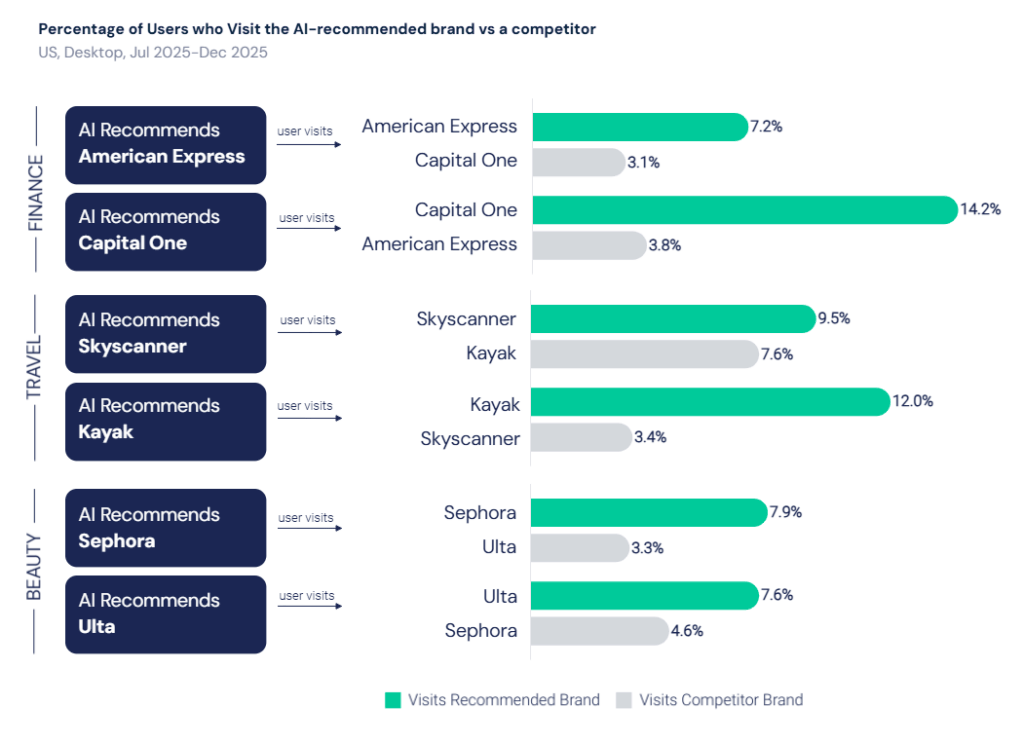
There’s a second finding worth pulling out too: where that traffic actually comes from. Only a small share arrives as a referral click from ChatGPT, and it’s not simply people typing the brand straight into their browser either, direct traffic was actually lower for AI-influenced visitors than for everyone else (19.9% vs 38.8%). Most of it, 55.9%, shows up as organic search on Google. The user gets a recommendation, remembers the name, and searches for the brand, rather than clicking through. Standard attribution reads that as branded Organic demand with no link back to the AI answer that caused it.
Which puts real weight on the health of your brand SERP. If a recommendation is going to encourage people to Google your brand name, what they see when they land there matters; who’s bidding on your name, whether review sites or social profiles are crowding you out on page one, your knowledge panel or GMB, that’s what actually decides what the visit turns into.
This is something most of us have assumed was happening for a while, that AI recommendations were influencing behaviour even without a click, we just haven’t had proper data behind it until now. Aleyda Solis flagged the same point off the back of this report: AI influence can happen with zero clicks, which is exactly why judging AI search value on referral traffic alone gets you the wrong answer. Everyone already knows AI referral traffic is small, the platforms have no incentive to send people away. Gaetano DiNardi made a related point from the B2B SaaS side: for most of his clients AI referral traffic sits around 5% against Google’s 95%, and he’s watching a “dark SEO” funnel emerge where buyers shortlist via AI, verify via Google, then convert via branded search much later in the journey. Same mechanism Similarweb just put numbers against.
If you’re still measuring AI visibility by referral traffic in GA4, you’ll conclude it isn’t worth the investment. This data says otherwise. Branded search lift and downstream engagement (AI-influenced visitors viewed 12 pages on average against 6.5 for everyone else) are where the value is actually landing, and most attribution models aren’t built to see it.
Google’s June 2026 spam update has finished rolling out
Google confirmed the June 2026 spam update is done, rolling out over 24 to 26 June,faster than the usual window. Google didn’t specify which spam policies it targeted this time, only confirming it excludes link spam and site reputation abuse. Chatter across the usual forums is mixed, some sites reporting drops of up to 80%, others seeing no change at all, and a few complaining spam is still showing up in results regardless.
Nothing conclusive to report yet. Worth keeping an eye on your own visibility data over the next few weeks if you work in a spam-adjacent niche, but there’s no clear pattern to call out beyond “it happened, and it landed unevenly.”
How ChatGPT actually picks its sources
This is a good from Suganthan – he read ChatGPT’s raw network traffic rather than just eyeballing outputs, and found some genuinely useful mechanics.
Every source ChatGPT fetches gets tagged with one of four pipeline values: `serp` (open web), `labrador` (a licensed tier, Reuters, WSJ, Wikipedia, publishers with content deals), `bright` and `oxylabs` (two commercial scrapers doing the bulk of the open web fetching). Unless you’re a licensed publisher, you’re competing in the scraped tier, so plain crawlable HTML matters more than ever.
A useful find is what happens with pricing pages. Watching the model’s own reasoning trace, he caught it trying to read a SaaS pricing page, failing because the numbers were loaded via JavaScript, then explicitly deciding to cite G2 instead because the official page “doesn’t show prices.” Your own facts, hidden behind JS, handed straight to a third party to state on your behalf.
There’s also a fetched vs cited distinction worth knowing. Reddit and YouTube got fetched at near identical rates in his sample, but Reddit was cited repeatedly and YouTube never once, likely because a citation needs to bind to readable text, and a search fetch only pulls YouTube’s metadata, not the transcript – a useful counter to the argument of Youtube being more important than ever re. its status regarding LLM influencing (it’s still an incredibly important channel however).
Sample size is small, around 1,240 records from one account, mostly SaaS and tech queries. The structural findings hold up, but treat the data as indicative rather than fixed. Worth reading properly if you’re working on AI visibility, the full piece goes further than we can cover here.
Dead in Google, surging in ChatGPT, and why you shouldn’t sleep on Bing
This case study is a good one. A YMYL site had effectively no visibility in Google, buried past page 7 for its own core terms, while pulling in over 90,000 citations in ChatGPT.
The explanation wasn’t some ChatGPT loophole. The site was ranking well on Bing, and ChatGPT’s grounding leans on Bing. Strong Bing visibility was translating directly into strong ChatGPT visibility, completely independent of what Google thought of the site.
Worth being clear on what this isn’t. The site looks like scaled AI content abuse, which is likely why Google buried it. If Google’s dropped a site that hard, there’s usually a reason, and it probably won’t survive there long term whatever’s happening elsewhere. This isn’t a workaround for badly built sites.
It’s just one example, but it’s a useful reminder that Bing visibility and Google visibility aren’t the same thing. Copilot and ChatGPT both draw heavily on Bing’s index, so it’s worth checking where your own Bing visibility stands rather than assuming Google performance tells the full story. Bing shouldn’t be an afterthought.
What 100 blogs over four years tells us about what’s still working
Daniel Stanica tracked 100 blogs from 2022 to 2026 and the numbers back up what most sites have been feeling for a while, the median blog in his sample lost 85% of its organic traffic, and 55 of the 100 are gutted or dead.
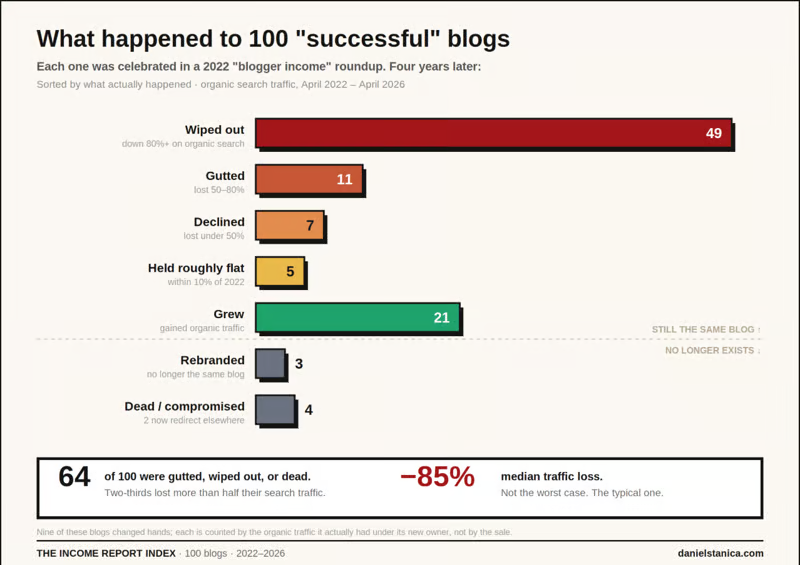
The more useful part is what separated the 21 that grew from everyone else. It wasn’t niche size or domain age, it was whether the content was something an AI answer could fully replace. Finance and health content, easily summarised, easily answered in a paragraph, dropped hardest (finance down 99%, health down 93%). Food, parenting and DIY content held up or grew, the kind of thing built on personal experience, testing, opinion and results that can’t just be summarised out from under you.
This is the same argument we’ve been making for years, just with fresh data behind it. Content that’s purely informational and easily compressed is the most exposed to AI answers. Content built on something only you have, direct testing, proprietary data, real experience, genuine opinion, is far harder to replace and it’s exactly the content that’s still growing.
Worth treating as a prompt to audit your own content set. If a page could be fully answered by an AI Overview without anyone needing to visit, it’s in the exposed category. If it depends on something you did, saw, tested or built, it’s in the defensible one.
Reuters Institute Digital News Report 2026: platforms overtake publishers, and use of AI as a news source is climbing
A big one this month, the Reuters Institute’s Digital News Report 2026 landed, and one of the headline findings confirms something most of us have suspected for a while: audiences aren’t going directly to news websites anymore.
Social media and video networks have now overtaken news organisations’ own websites and apps as the most widely used way people access news globally, used by 54% of respondents weekly compared to 51% for owned news properties.
The takeaway for digital PR: if direct traffic to owned news websites is shrinking, and audiences are increasingly consuming journalism on YouTube, Instagram, TikTok and inside AI answers, earning coverage on a publisher’s own site is no longer the end goal in itself. The story’s reach, and a brand’s exposure with it, depends more and more on whether that coverage gets picked up, reshared or cited beyond the original page, on the platforms where more readers and viewers now actually are.
Google tests ‘Top Stories’ carousel within AI Overviews
Last month we covered the Preferred Sources rollout. Google has now begun testing a Top Stories carousel inside AI Overviews. Early screenshots show the carousel surfacing content from outlets including the New York Times and Yahoo, with Google previously confirming it will also highlight a user’s Preferred Sources where relevant.
This was pre-announced back in May, when Google said it would help “make timely articles more visible on a wider range of queries” for developing news topics. It reinforces the direction of travel we flagged last month, timely, authoritative reporting is increasingly being given its own dedicated visual real estate inside AI-generated answers.
For digital PR, reactive commentary continues to look like one of the most reliable routes into these AI surfaces, provided it’s landing with publishers fast enough to be “timely” in Google’s eyes.
In our upcoming webinar, Digital PR for AI: Why Expert Voices Matter More Than Ever, on Wednesday 15th July, we’ll be digging into this a bit more, so do come along if you’re free.
UK Government proposes giving “trustworthy” publishers prominence on YouTube and social feeds
The UK Government has published a consultation, “Watch this Space: A new strategic direction for UK media,” proposing that content from “trustworthy” news publishers be made easier to find on platforms like YouTube and Meta’s apps, potentially including prominent placement at the top of search results for news-related queries on those platforms.
We’re already seeing AI platforms lean heavily on YouTube as a source. Ahrefs’ Q1 report last month identified it as the single strongest signal for AI brand visibility, and the Reuters Institute’s new report this month confirms YouTube remains comfortably the biggest video network for news, used by 69% of respondents globally.
If proposals like this do eventually push authoritative publisher content higher up YouTube and social feeds, there’s a real possibility of overlap forming: the same content becoming more discoverable both through platform algorithms directly and through AI-generated answers that are already citing YouTube heavily.
Enjoyed this roundup? Stay updated with the latest organic trends, tips, and exclusive insights by subscribing to our newsletter.
Want cutting-edge digital news and tips straight to your inbox? Sign up to our monthly newsletter here
"*" indicates required fields