Organic Search in 2026: An Update on Strategy and Priorities
 Matthew Finch
TL;DR
Clicks are harder to win, attribution is noisier, and search journeys are less linear, but organic remains commercially critical. The brands that win in 2026 won’t abandon SEO fundamentals; they’ll extend them, using deeper user insight, authority, and smarter intelligence to influence decisions before the click ever happens.
Organic search is changing, but demand hasn’t gone away.
Despite falling click-through rates and the rise of AI-driven search experiences, organic search remains one of the most commercially important channels for most businesses. For the majority of our clients, it still sits top two for both clicks and revenue attribution, even as the mechanics of how visibility is earned continue to evolve.
What has changed is where influence happens, how decisions are formed, and how performance should be interpreted.
This post is a top-level look at where organic search stands heading into H1, what still matters, and how strategies are evolving in response.
Where We Are With Search Right Now
Search demand hasn’t disappeared, it’s fragmented.
Google remains the dominant discovery platform and still underpins organic performance for most brands. However, recent industry data shows Google referring around 16% less organic traffic to websites than at the start of last year, reflecting a combination of AI Overviews, richer SERPs, rise of LLM usage and direct website visits, and more on-platform journeys.
This drop is real, and it’s affecting everyone.
At the same time:
- Organic search continues to be a top contributor to revenue, even as click volumes decline.
- Many users now arrive with clearer intent and expectations – having already seen summaries, comparisons, or answers before clicking.
- Fewer clicks doesn’t automatically mean less impact.
The channel hasn’t weakened – the path to value and ROI has become less linear.
Why Rankings and Traffic Alone No Longer Tell the Full Story
Historically, organic success followed a simple logic:
Rank → Click → Convert.
Today, that model is incomplete.
AI Overviews, featured answers, reviews, forums, and social content increasingly influence users before they click on an Organic result (if they click at all). Brands are being shortlisted, evaluated, and sometimes ruled out earlier in the journey.
This creates two important realities:
- You can lose clicks while still winning demand.
- You can rank well and still lose influence if your brand isn’t trusted or visible elsewhere or in the right places.
This is also where attribution becomes harder.
As we’ve discussed in our recent organic round up posts and webinars, attribution has become murkier across the board:
- GA4 data is increasingly incomplete.
- Consent, privacy tooling, and AI platforms remove users from measurable journeys.
- Assisted influence often isn’t reflected in last-click reporting.
Lower clicks don’t automatically equal lower value – but interpreting performance now requires far more context and nuance. For our larger clients, we are now dedicating increasing time per month on this side of things as the importance of highlighting organic contributions to commercial success has never been higher.
How Visibility Is Earned Now
Modern search engines and AI systems defer judgement to the wider web.
Visibility is no longer determined by:
- A single page
- A single ranking
- Or a single platform
Instead, it’s shaped by:
- Authority and expertise signals
- Brand mentions and narrative consistency
- Reviews, sentiment, and public opinion
- Coverage across the surfaces where users research and compare
In short, reputation now compounds into search visibility.
This is why Digital PR, brand authority, and off-site signals are no longer “supporting” visibility aims, they’re integral to it.
How Organic Strategy Is Evolving in Practice
Organic strategy in 2026 requires both breadth and prioritisation. You still need strong technical foundations and core SEO work; these are the base criteria for inclusion in Google and AI discovery. At the same time, brands must allocate effort toward the areas where competitive advantage and influence compound fastest.
For some, this means deeper authority work and off-site signals. For others, it means smarter measurement and feedback loops. What always matters is clarity on why those areas are prioritised, not just that they are.
As one example, we’ve recently helped a large client reframe their organic investment around a small number of priority themes for the year ahead (AI visibility, authority, content depth, foundations, intelligence, and conversion efficiency). Presenting strategy this way made it far easier for stakeholders to understand what they were investing in and why, and helped unlock increased budget despite current search headwinds.
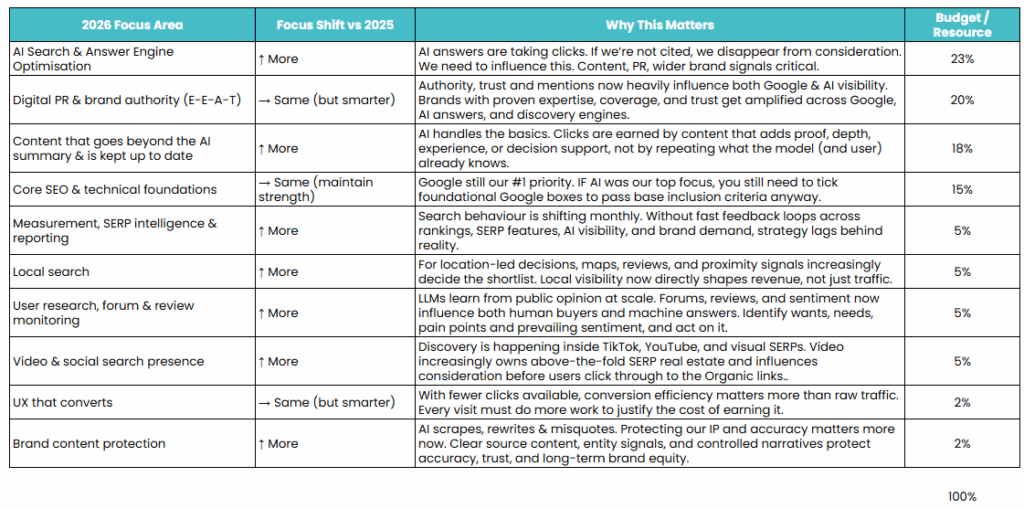
This isn’t a fixed model. The mix flexes by market, maturity, and ambition. But the underlying principle is consistent: effort needs to be directed where it has the greatest commercial and visibility impact.
Unlocking Deeper User Insight Than Search Data Alone Allows
Traditional search data tells us:
- What people type
- When demand is large enough to measure
- How queries trend over time
What it doesn’t show particularly well is:
- How people complain
- What frustrates them seasonally
- What nearly stops them buying
- The language they use outside search engines
To address this, we’re increasingly supplementing keyword data with large-scale analysis of publicly available conversations across forums, reviews, and social platforms plus our own user, team, and customer interviews.
This allows us to:
- Identify unmet needs and objections that never become keywords
- Spot seasonal pain points before they spike in search demand
- Understand how users actually describe problems in their own words
Some of the most commercially valuable insights either don’t appear in keyword tools at all, or when they do, your competitors see the same data, so at best you have parity only.
Turning Sentiment Into Strategic Advantage
One of the most powerful outcomes of this approach is the ability to surface recurring positives and negatives at scale.
By aggregating reviews and discussions over time, clear patterns emerge:
- Seasonal frustrations
- Product or service strengths users consistently praise
- Perception gaps between how brands describe themselves and how customers experience them
These insights can then directly inform:
- Content strategy
- PR angles and messaging
- UX and conversion improvements
- FAQ and support prioritisation
This strategy reveals not just what your own brand is doing well or poorly, it highlights where competitors are weak, and when those weaknesses matter.
With this insight, you can design targeted omni-channel campaigns that fill gaps and claim advantage. That might include:
- proactive content addressing common complaints
- digital PR highlighting strengths where rivals falter
- UX/CTA enhancements tuned to specific friction points
- paid + organic messaging alignment that exploits a competitor’s blindspots
This isn’t theoretical; it feeds directly into execution across search, social, reviews, and earned media.
Reverse-Engineering How AI Makes Decisions
AI-driven search adds another layer.
Large language models don’t answer questions randomly. They:
- Pull from a finite set of sources
- Expand queries into multiple related sub-questions
- Synthesize recurring themes across content types
Beyond tracking which sources are cited, we’re increasingly focused on understanding:
- Who is winning visibility for the prompts that matter
- What themes and attributes are consistently reinforced
- Where competitors are better represented and why
Tools like Peec.ai are useful here. They’re not perfect, but they currently offer one of the clearest interpretations of what users are actually shown when searching for the prompts and topics we care about.
The value isn’t the metric itself – it’s what it enables:
- Identifying gaps in brand representation
- Understanding which narratives are being amplified
- Reverse-engineering the signals that influence inclusion
From there, strategy becomes far more actionable – improving offerings, strengthening content, or amplifying the right messages through PR and content marketing.
Where This Is Heading
As we move into Q1 and beyond, organic strategy is becoming:
- More intelligence-led
- More integrated across channels
- More responsive to changes in how people search and make decisions
This doesn’t replace SEO fundamentals; it builds on them.
The strongest brands will be those that:
- Maintain technical and content excellence
- Build authority and trust consistently
- Understand their audiences better than search data alone allows
- Measure influence, not just clicks
A Final Note on Strategy
This post reflects the top-level priorities we believe matter most in the current search landscape.
However, every website, market, and niche is different.
Specific tactics, weightings, and areas of focus will always depend on:
- Your current visibility and authority
- Your competitive environment
- Your commercial priorities and constraints
That’s why each client’s strategy is tailored to their starting point and evolves as signals change. Your account team’s role is to translate these principles into a plan that reflects your reality, not a generic checklist.
Organic search is evolving – not disappearing.
The opportunity remains substantial for brands willing to adapt how they think about visibility, influence, and growth.
Want cutting-edge digital news and tips straight to your inbox? Sign up to our monthly newsletter here
"*" indicates required fields