Latest organic search news – March 26
 Matthew Finch
 Ella Grappy
We’ve compiled the essential updates from Google and the broader world of search from the last month – keeping you up to date with everything you need to know.
TL;DR
- New research suggests losing Google visibility may also reduce AI citations. A small but directionally useful study suggests organic visibility drops are mirrored by reduced citations across AI Mode, ChatGPT, Gemini and Perplexity.
- February click drops weren’t just self-promotional listicles being targeted. Instead, Google moving AI Overviews onto a newer Gemini model, likely improving answer quality is what’s impacted things here.
- It’s not just AIOs eating into organic clicks. Aleyda’s ecommerce SERP study shows paid click share rising YoY, but organic still takes the majority of clicks.
- AI citations favour front-loaded content. Kevin Indig’s research suggests a large share of citations are pulled from the first third of a page, making early clarity and headline takeaways (proper TL;DRs) more strategic than ever.
- LondonDM #1. We’re hosting our first Distinctly-run in-person digital marketing event in London, focused on practical discussion on what’s working right now across search, AI and wider marketing.
New research suggests losing Google visibility may also reduce AI citations
Lily Ray published a useful study in February, which added fresh data and perspective on the relationship between organic visibility and LLM citations.
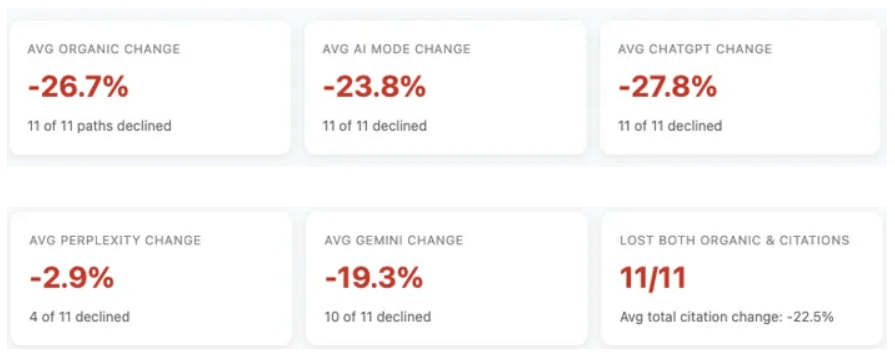
The study tracked a group of pages impacted by January’s unconfirmed Google update and then measured what happened to those same pages within LLM results, including Google AI Mode, ChatGPT, Gemini and Perplexity.
Read the original write-up for the full methodology, but the headline takeaway was straightforward: when pages lost organic visibility, they also tended to lose AI citations.
Across the sample, organic visibility declined and citations dropped across almost every model at the same time. The dataset is still relatively small, so this is directionally relevant rather than conclusive, but it aligns with our current view on search at present.
The interesting question is why.
For Google’s own AI products the explanation is fairly intuitive. If AI Mode and AI Overviews are built using Google’s index and trusted results, then losing rankings upstream would naturally reduce how often those pages are referenced in generated answers.
Third-party models are less transparent technically, but the relationship still makes sense.
When you add scale into the equation, the importance of ranking highly organically only grows.
Google search traffic still dwarfs that of LLMs, so most search-driven visibility – both traditional and AI – is still flowing through the same upstream selection process.
From our perspective, this helps clarify the “SEO vs GEO” discussion. On the whole, AI visibility doesn’t sit separately from SEO; it sits alongside and downstream of it. Improving authority and organic presence doesn’t just influence Organic clicks; it influences whether you are selected as a source at all. Equally, losing organic visibility may have a cascading impact across AI systems as well.
If you want the deeper dive and data breakdown, I’d recommend reading the original article alongside this.
February click drops… not just self-promotional listicles being targeted
What everyone thought was happening
Last month a lot of sites saw noticeable drops in clicks and impressions. The first reaction across the industry was fairly consistent: Google appeared to be cracking down on the wave of self-promotional “best X for Y” content designed primarily to be picked up and cited by LLMs.
There were plenty of examples where those types of pages lost visibility or were effectively de-indexed, so the assumption made sense.
(Side note: I’m always up for testing new tactics, but when something is inherently spammy, even if it works short-term there are no guarantees it lasts nor that it doesn’t hurt the health of your website mid-term, and the recovery cost can be high.)
What the data suggested instead
Clearscope went a step further and looked beyond page types. Their data showed the decline wasn’t limited to those articles. Clicks and impressions were falling more broadly, including across pages that weren’t using those tactics at all.
That pointed to something wider than a targeted quality update.
The key change: Gemini powering AI Overviews
The timing aligned with a product change rather than a ranking change. In January, Google moved AI Overviews onto a newer Gemini model.
The most likely impact was simply better answers.
If the results page resolves more of the query directly, fewer users need to click. The search still happens, but the visit doesn’t.
Why this matters
So if you’ve seen traffic decline without corresponding ranking drops, this may be part of the explanation. It’s less about being penalised and more about queries being satisfied earlier in the journey. Some of the loss in clicks may not be SEO performance changing, but how Google delivers answers changing.
Clearscope also make a good point in their write-up around what this means for SEO. If this were just a page-type issue, the response would be tactical. But the evidence suggests something broader: more of the intent resolution is happening directly in the results interface itself.
That shifts part of the competitive surface away from rankings alone and into whether your content is represented inside the answer layer. Success is no longer defined purely by position or traffic, but increasingly by whether you are included in how answers are constructed.
The uncomfortable implication is that, for some query types, previous traffic levels will simply not return. Not because SEO has failed, but because the way search fulfils intent is changing – so our advice is to focus on the activity that moves the commercial needle as much as possible. And if that still means focusing on inclusion in AIOs, you know what to do.
It’s not just AIOs eating into organic clicks…
Another useful study this month came from Aleyda Solis, who analysed over 5,000 ecommerce queries to understand how the SERP itself is changing.
The interesting part is that this wasn’t just about AI Overviews reducing organic clicks. The data showed a clear increase in the share of clicks going to paid results year-on-year.
Across the four ecommerce verticals analysed:

This isn’t especially surprising. Google is an advertising business, and anyone actively monitoring the SERPs over the last few months will have seen how:
- ads are increasingly similar in appearance to organic listings
- they appear throughout the results page, not just above it
- they include richer features designed to attract interaction
It suggests some of the clicks organic once received are now being captured by paid placements instead.
The picture that starts to emerge is a more layered results page rather than a weaker organic channel:
- informational queries are increasingly answered directly in the results
- commercial queries are often accompanied by stronger paid placements
Importantly, this doesn’t mean ads outperform organic. Even with the increase, organic results still receive the majority of clicks when a user chooses to visit a website. What has changed is competition for attention on the page.
That helps explain why rankings alone no longer tell the full story. A page can hold position but see traffic change as the surrounding SERP evolves.
Why this matters
Measuring rankings without measuring the SERP is becoming unreliable. If ad units expand, AI Overviews appear, video modules increase, or forums and social platforms take space, the opportunity available to organic results changes even if the ranking does not.
This makes SERP monitoring far more important:
- tracking features, not just positions
- monitoring how often AI Overviews appear
- reviewing pixel depth, not just rank
- comparing today’s layouts with 6–12 months ago
It also reinforces the need for joined-up strategy. If more commercial clicks are moving into paid placements, SEO and paid activity can’t be treated as separate channels. Understanding when organic visibility is constrained and where paid can capture intent becomes part of the same conversation.
Finally, the study also showed growing presence of YouTube, Reddit and other social platforms within results. That again supports the idea of “search everywhere”: visibility is no longer limited to traditional webpages, and brands investing in those platforms are more likely to appear across the modern SERP.
A final point
There’s another way to interpret this. If fewer clicks are available overall, the value of the remaining ones increases.
When users do decide to leave the results page, they are typically further along in their decision-making and more intentional about where they click. That concentrates opportunity towards the top of the organic results.
In practical terms, this actually raises the importance of SEO. With less traffic to go around, ranking highly and maintaining strong visibility becomes more critical, not less.
New study finds AI citations favour ‘front-loaded’ content – but what does that mean for digital PR campaigns?
In February, Kevin Indig released a study which analysed 1.2 million ChatGPT answers, which revealed that nearly half (44%) of citations are lifted from the first third of a page’s content, following what he described as a ‘ski ramp’ pattern.
Some additional findings for context:
- 44.2% of all citations come from the first 30% of text (or, the intro) – Indig described this similarly to the way a journalist would read a page, grabbing the “who, what, where”
- 31.1% come from the next 30-70%
- 24.7% come from the last third of an article (the ‘conclusion’), with a huge dropoff when it comes to the final 90-100% (the ‘footer’)
Understandably, when it comes to creating an on-site report, it can be tempting to spend time (and words) setting the scene, explaining the context, and describing the methodology first; however, this means that data-led campaigns, e.g. surveys, reports, etc can get buried under lengthy preambles which may not be as beneficial when you’re looking to increase AI visibility.
So, lead with the headline stat in your first few sentences, put your key findings in the first section of your piece, and start reframing ‘TL;DRs’ as a strategic asset rather than an afterthought.
The same principle that helps to keep journalists engaged in your content now determines whether AI references your content at all.
LondonDM #1 – our first Distinctly-hosted marketing event
Finally, something slightly different from algorithm changes and SERP studies. We’re hosting the first LondonDM event, an in-person digital marketing evening bringing together SEOs, PRs, paid specialists and in-house marketers to talk about what’s actually working right now.
The aim is simple: practical discussion, shared experiences, and honest conversations about how search, AI and marketing strategy are evolving beyond theory and blog posts.
If you’re London-based (or nearby) and work in marketing, you’re very welcome to join us. Details and registration are here:
https://www.eventbrite.co.uk/e/londondm-1-digital-marketing-event-tickets-1982774245142
We’re hoping to make this a regular meet-up, so it should be a good chance to compare notes with people facing the same changes in search and discovery.
Want cutting-edge digital news and tips straight to your inbox? Sign up to our monthly newsletter here
"*" indicates required fields