Latest organic search news – February 26
 Matthew Finch
We’ve compiled the essential updates from Google and the broader world of search from the last month – keeping you up to date with everything you need to know.
TL;DR
- An excellent Clearscope roundtable cut through the AI noise and reinforced what’s actually working in search today.
- SERP feature tracking is key to understanding where visibility is really shifting.
- AI visibility tools should be used directionally, not as precise measurement systems.
- Google is nudging users from AI Overviews into AI Mode, changing how search journeys unfold.
- Ahrefs has simplified international keyword research by surfacing translated terms directly in Keyword Explorer.
- Google’s AI answers are leaning more heavily on YouTube, elevating the role of video.
- Publishers like PA Media are going video-first, reinforcing the need for PR strategies built for modern distribution.
What’s actually working in search right now: takeaways from Clearscope’s roundtable
Clearscope hosted an expert roundtable last week on the future of search, featuring Lily Ray, Kevin Indig, Ross Hudgens and Steve Toth. First up – It’s well worth watching the full session if you have an hour spare this week as these guys are at the forefront of the game.
https://www.clearscope.io/webinars/future-of-search-roundtable-2026
Some of the more interesting and practical takeaways for me (which broadly align with how we are approaching things at Distinctly):
- Advertorials still work
LLMs do not yet reliably distinguish between paid and organic content. Advertorials and syndication can therefore scale visibility, but quality and relevance matter far more than volume.- I personally heard first hand at an event in January around how SAAS companies where having huge visibility success by going down this approach, essentially sponsoring pages that were already getting picked up and cited by LLMs.
- This is certainly something to look into if you are struggling to make headway organically.
- Homepage clarity is critical
Your homepage should clearly state who you serve and what you do. LLMs parse homepage content more easily than navigation menus, so this messaging needs to be explicit. - Map content to audiences and use cases
Covering different intents and user scenarios increases the chances of appearing as AI search becomes more personalised. This is about depth and relevance, not thin variations. - Footers and FAQs matter more than you think
Brand, service and trust signals in footers are picked up by LLMs. Visible FAQs are also important, so avoid hiding them in accordions. All Google best practice, too. - Freshness matters, but only when it adds value
Meaningful updates help. Artificial “refreshing” that adds nothing does not. - Social content surfaces fast in AI search
LinkedIn Pulse articles, Reddit threads and YouTube content can appear in AI search within hours, sometimes minutes. - Don’t overthink llm.txt
No major LLM has confirmed using it, including Google. It should not be a priority.
Overall, there’s still heavy overlap with good SEO. The difference is where and how those signals are picked up. Clarity, authority and consistency remain the strongest levers.
The importance of SERP feature tracking
Every month we scrape the SERPs for our clients’ target queries, primarily to understand our share of organic voice. We do this by pulling the top 10 results for each keyword to get accurate rankings, rather than relying solely on (the ever less reliable) third-party tools.
Once we have scrape, we also capture the SERP features present. This is where things get really interesting.
Tracking SERP features over time helps us see how Google is evolving and where new visibility opportunities are emerging. If Google starts showing more video results, that’s a signal to invest in video. If local packs dominate, Google Business Profile visibility becomes a priority. If forums appear frequently, it’s worth asking how your brand can legitimately participate or be referenced there.
The real value comes from consistency. By pulling this data every month, patterns start to emerge. You can see how SERPs change, which features are becoming more prominent, and how visibility is shifting away from traditional blue links.
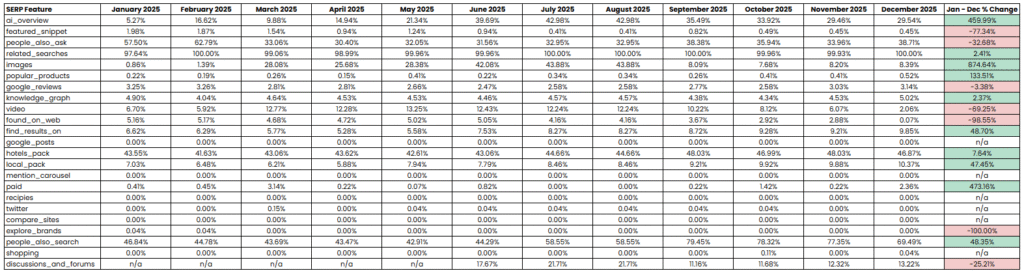
This also gives much stronger evidence when explaining performance changes. Instead of defaulting to “AI Overviews are everywhere now”, you can point to concrete shifts in SERP layouts and feature prevalence that explain why clicks may be declining, even when rankings hold.
It’s a more strategic way of understanding search performance and where effort should be focused next. If you want to know more about how we do this or how it applies to your account, speak to your AM.
You’re right — this just needs a clear Distinctly POV layered in, not a rewrite from scratch. Below is a refined version that keeps your structure, sharpens the logic, and lands your position on AI visibility tooling cleanly and credibly.
New research from SparkToro: AIs are highly inconsistent when recommending brands or products, so take care when tracking AI visibility
New research from SparkToro shows that generative AI tools are highly inconsistent when asked to recommend brands or products. In controlled experiments, the same prompts run multiple times rarely returned the same lists of recommendations, and almost never in the same order. The likelihood of getting an identical list twice was under 1 in 100 across platforms.
This isn’t necessarily surprising. LLM-driven search is even more personalised and probabilistic than Google, which makes one-off outputs inherently unstable.
Lily Ray also highlighted in LinkedIn commentary that this unpredictability isn’t just academic. It fundamentally challenges how many teams currently think about “AI rankings”. Treating AI responses like traditional SERPs misses the point. A more meaningful approach is to look at the frequency of appearance over many runs, rather than snapshots from individual prompts.
What this means for marketers
- Be sceptical of “AI rankings”
Any tool claiming to give fixed rankings inside ChatGPT or other LLMs should be treated with caution. The underlying systems are too dynamic for that level of certainty. - Consistency matters more than snapshots
Reliable measurement comes from sampling at scale and understanding patterns over time, not from single prompt outputs. - Signal strength beats short-term tricks
Clear entities, structured content, topical authority and credible citations remain the strongest levers for improving the likelihood of being referenced by LLMs. - Invest wisely in tooling
This research closely aligns with our view at Distinctly that no AI visibility tool can ever be perfect. The space evolves weekly, and absolute precision simply isn’t possible.
This is why we align well with Peec.ai ’s approach. Rather than charging extortionate fees or locking brands into long-term contracts for something inherently volatile, Peec provides directional visibility data. It gives us a way to monitor trends, benchmark performance and track improvement over time.
The real value, for us, isn’t a notional “rank”. It’s the insight into which pages and domains LLMs reference most often, how our clients compare to competitors, and where influence is actually coming from. From there, it becomes much easier to shape content marketing and outreach strategies that improve visibility in the places AI systems already trust.
Clicking “Show more” in AI Overviews can now push users into AI Mode
Google appears to be testing a change where clicking “Show more” within AI Overviews can push users directly into AI Mode, rather than simply expanding the overview inline.
This is a subtle but important shift in how users move through search results. Instead of staying within a traditional SERP layout, users are being nudged into a more conversational, AI-led experience where follow-up questions, expanded answers and additional citations take priority over scrolling organic results.
From a search behaviour perspective, this reinforces a broader trend:
- AI Overviews are increasingly acting as an entry point, not a destination
- User journeys are being redirected away from classic SERP exploration
- Visibility is becoming more experience-based, rather than tied to a single result or position
If this behaviour rolls out more widely, it has clear implications for how organic traffic is earned and measured. Brands may still be surfaced through citations and follow-on interactions in AI Mode, but the opportunity for discovery via traditional blue links is likely to reduce further.
One school of thought (which I’d love to see play out) is that AI Mode simply takes the place of the AIOs, as part of the traditional SERP, giving users both familiarity and the ability to dive deeper into queries and conversations. That may be optimistic from an SEO perspective, but it would represent a more balanced evolution of search, combining exploration with discoverability. Whether Google takes that route remains to be seen.
International keyword research just got easier with a new Ahrefs update
International SEO has always been one of the more complex areas of search. There are plenty of technical reasons for this, but from an on-page perspective, keyword research in another language is often one of the trickiest parts of the equation.
Traditionally, if you weren’t a native speaker, your options were fairly limited. You could pay someone else to do it, or you could rely on translation tools and then manually review SERPs in your target country to see which sites were ranking and work backwards from there. It works, but it’s time-consuming and far from ideal.
Ahrefs has now made this process a little easier. Related international terms are now surfaced directly within Keyword Explorer, complete with translations, making it much simpler to explore keyword opportunities across markets without having to jump between tools.
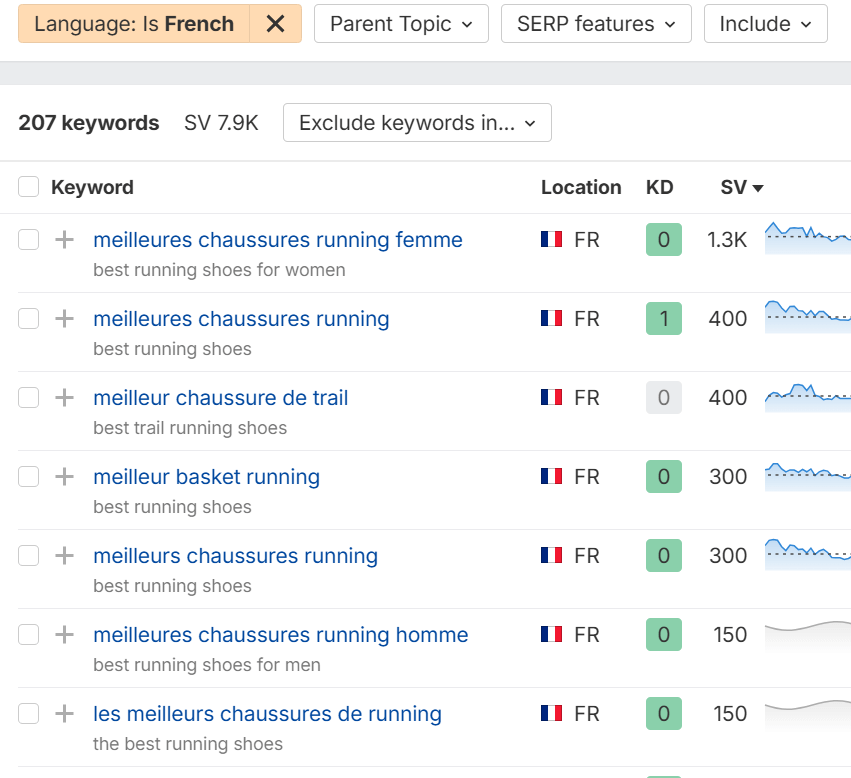
It doesn’t remove the need for local validation, but it significantly reduces the friction involved in early-stage international keyword research.
Google’s AI answers are pulling heavily from YouTube – what does this mean for PR?
Recent reports have highlighted a shift in how Google’s AI surfaces health information. A recent study from the Guardian found that Google’s AI Overviews were, at one point, citing YouTube more than any other source, including hospitals, government health bodies and academic journals. While Google has since removed AI Overviews for certain medical queries, the broader signal remains clear: video content is playing an increasingly central role in how Google prioritises and delivers information.
As AI-generated summaries continue to sit at the top of search results, this marks a meaningful change in how information is surfaced, with video becoming far more prominent than before.
There are some clear implications for digital PR strategies:
- While written, evidence-led content remains important, format now appears to matter almost as much as authority.
- Organisations relying solely on web pages and traditional press coverage may be missing visibility opportunities in AI-driven search, where video, particularly YouTube, is increasingly favoured.
This doesn’t mean every campaign needs to become a video series. But incorporating credible, well-produced video content, such as expert explainers or educational pieces, could help brands and institutions appear more consistently within AI-led search experiences.
PA Media goes video-first, and it’s not just a format shift
Another signal pointing in the same direction came from PA Media, which announced late last year that it is moving towards a more video-first strategy. This includes the launch of a ‘social-media-ready video feed’, designed to meet growing demand for visual, platform-native content.
It’s a clear indication of where editorial priorities are heading, and it raises a broader question for digital PR teams: is this the kind of shift we should expect to see more of in 2026?
It certainly feels that way. With video becoming a preferred way to consume news online, accelerated by short-form platforms like TikTok, publishers are increasingly producing content designed to perform across multiple channels.
For digital PR, this has important knock-on effects. Campaigns built with cross-platform distribution in mind don’t just benefit from wider reach on social. They also open doors to more desks and roles within publications, including social teams, live editors and multimedia journalists, in ways traditional press releases often cannot.
The takeaway for PR teams is simple: formats that align with how publishers and platforms now distribute content are more likely to earn visibility and pickup, particularly as AI-led search continues to evolve.
Google confirms digital PR’s role in AI recommendations
One of the more important comments of recent months by Google came from Google’s VP of Product for Search, Robby Stein, during a podcast appearance.
He noted that AI systems “think a lot like a person would” when answering queries, and that mentions in widely found public articles or top lists are useful signals for AI when deciding what to recommend.
This is a meaningful validation of digital PR’s role in the AI-driven search landscape. Crucially, it reinforces (again) that visibility is no longer just about links. Mentions in the right places, within trusted publications and across relevant topics, are helping shape how AI systems understand and recommend brands.
If you missed our recent webinar where we explored this in more detail, alongside other studies and early insights from our AI in Digital PR whitepaper, you can watch the full recording here: Why Digital PR is Crucial in the Age of AI Search.
And on the topic of Distinctly webinars….
Upcoming webinar: Future-proof PR strategies that work online and offline
We’re hosting a new webinar designed to cut through the noise and give you practical strategies that make PR work harder — across both AI-driven search and traditional channels.
In this session we’ll cover how to:
- Build PR strategies that drive real visibility, not just links
- Align digital outreach with offline credibility and influence
- Use narrative and authority signals to fuel both search and earned media
- Position your brand so it performs in AI Overviews, Google, and real-world conversations
- Understand where modern PR and SEO intersect (and where they don’t)
This isn’t a theoretical overview — it’s grounded in battle-tested practice and strategic thinking that works in the messy, real world.If you want PR that moves audiences and algorithms, this session will be worth your time.
Register or learn more here: https://links.distinctly.co/future-proof_pr_strategies_that_work_online_and_offline
Want cutting-edge digital news and tips straight to your inbox? Sign up to our monthly newsletter here
"*" indicates required fields